The First-Touch Difference: Mechanism & Depth
Here’s where most comparisons go wrong. You’ll often see “a roller is for puffiness, gua sha is for contour.” That’s surface-level thinking. The real distinction lies in the biomechanical action each tool creates on your skin and underlying tissues.
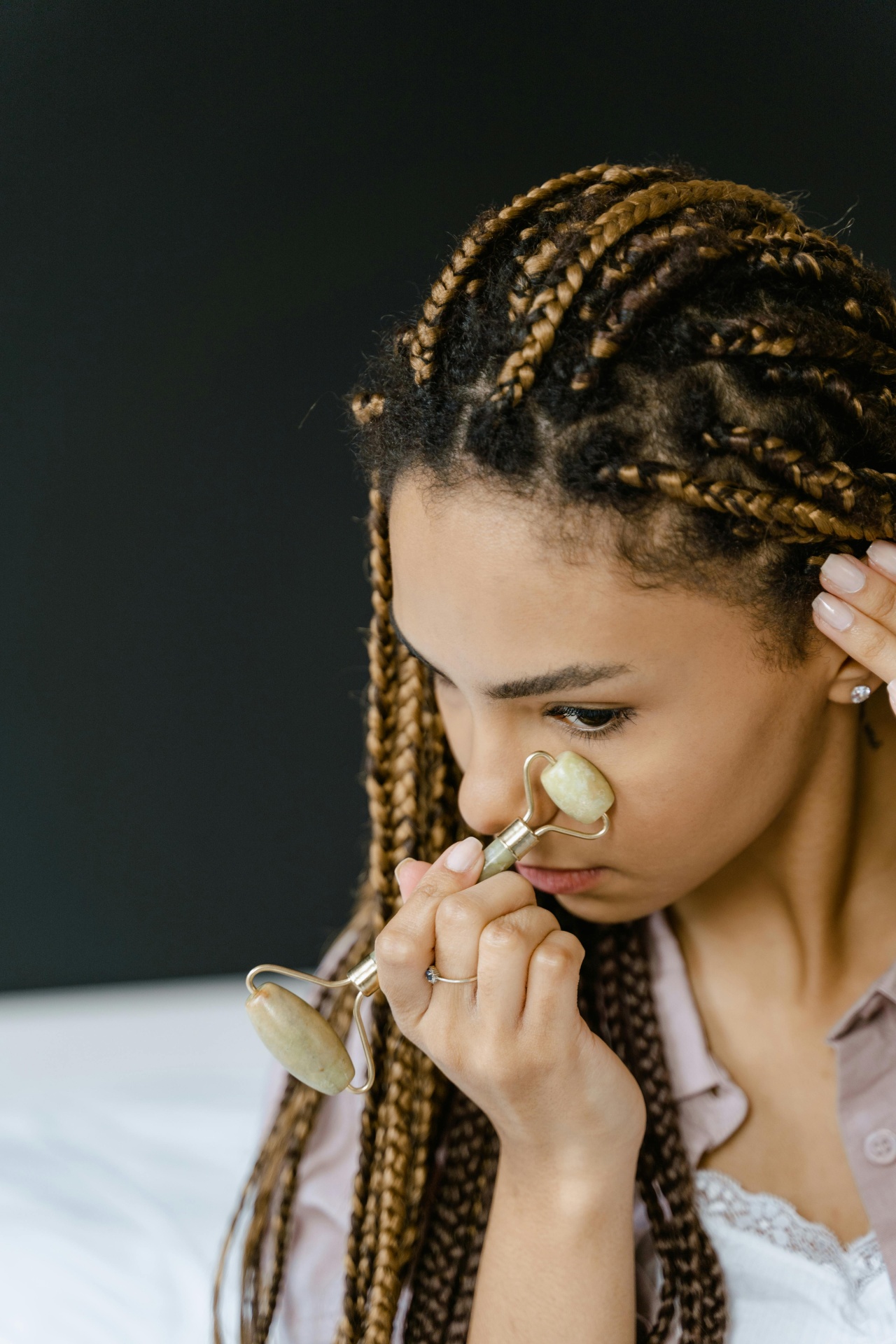
A jade roller works through a gentle, rolling compression-decompression cycle. The cylindrical stone moves with your hand, applying an intermittent, shallow pressure wave that primarily encourages interstitial fluid movement within the superficial layers of the dermis and the lymphatic network just beneath the skin. Think of it like a delicate pump: it pushes sluggish fluid toward lymph nodes without substantially engaging the underlying musculature. For a complete step-by-step walkthrough on harnessing this pumping action effectively, you can review How to Use a Jade Roller Correctly: Step-by-Step Guide.
Gua sha, on the other hand, is a shear-based fascial release technique. When you hold a shaped stone at a 15- to 30-degree angle and glide it with intentional pressure, you are manipulating not just fluid, but the superficial fascia—a cling-film-like layer of connective tissue that envelops your muscles. This action helps temporarily release adhesions between the skin and muscle layers, promoting microcirculation beyond what a roller can achieve. The result is more pronounced, longer-lasting contouring because you are relaxing the underlying hypertonic muscles that pull your face down.
So, the difference isn't “deep vs. shallow” in a vague sense. It's fluid pump vs. fascial fascia unwind. One manages the morning’s fluid load, the other resets the day’s accumulated expression tension.
Lymphatic Drainage vs. Muscle Tension: What Are You Actually Treating?

Your skin’s morning face is a different organ from its evening face, and this is the core of the decision. Let’s break down the biological mismatches many people don’t talk about.
Morning Scenario: The Gravity of Fluid
You wake up, and your eyelids look creased from sleep, your jawline feels blurred. This is orthostatic-induced fluid pooling. Your lymphatic system, which has no central pump, slowed overnight. A jade roller, especially if you chill it for 10 minutes beforehand, is an unmatched ally here. Its rolling action perfectly mimics the physiological “unidirectional” valve gating of lymph vessels. You don’t want to press and scrape fascia at this stage—the tissue is too engorged, and aggressive gua sha can actually temporarily congest lymphatic pathways if you push too hard. I've seen clients make this mistake: going in with a stone directly on puffy cheeks and creating temporary red welts from fluid back-pressure.
Evening Scenario: The Petrification of Expression
By 7 PM, your “11” lines between the brows feel like they’ve been set in concrete. Your jaw from clenching during a long work call is tight. Fluid isn’t your enemy now—chronic, low-level muscle hypertonicity is. This is where gua sha shines. Gua sha’s edge can hook under the masseter muscle’s gripping point and release the tension that a roller, with its large, convex surface, simply cannot access. The stone’s ability to conform to the sharp angles of your jawbone and brow ridge provides an immediate “unlocking” sensation that’s dramatically different from a roller’s smoothing effect.
Head-to-Head: A Technical Feature Table
Raw, unfiltered technical specs matter when the marketing copy fails you. Here’s a breakdown that respects your intelligence.
| Feature | Jade Roller | Gua Sha Board |
|---|---|---|
| Primary Action | Compression wave, fluid pump | Shearing, fascial release |
| Best For | Morning puffiness, product absorption | Deep tension release, lifting, contouring |
| Required Skill | Low: intuitive up-and-out motions | High: requires angle control, pressure modulation |
| Pressure Level | Light to moderate | Moderate to firm (no bruising) |
| Angle Requirement | Perpendicular to skin (natural roll) | 15°–30° to skin surface (critical) |
| Typical Session Time | 3–7 minutes full face | 5–15 minutes full face |
| Maintenance | Wipe after each use; harder to clean crevice at roller joint | Wipe after each use; easier to fully sanitize flat stone |
Scenario-Based Decision Guide: Which One Should You Pick Right Now?

Abstract “which is better” debates are useless. The tool is only as good as its fit for your specific, concrete situation. Pick your primary profile from the list below; that’s your answer.
Pick a Jade Roller If…
- You are a complete beginner to facial tools. The margin of error is nearly zero. You roll, you calm, you depuff. It’s an accessible entry point before you graduate to more technique-sensitive tools.
- Your primary, non-negotiable complaint is morning facial puffiness, especially around the eyes. The cooling nature of authentic jade (a naturally cold-retentive stone) combined with the rolling motion cuts drainage time in half.
- You want to supercharge your serum absorption. Research indicates that mechanical massage can enhance transdermal penetration of certain active ingredients up to twofold compared to passive application. A roller creates a rhythmic push for your actives.
- You have sensitive, reactive, or rosacea-prone skin that flares up with friction. A roller’s gentle, lifting touch is safer than a gua sha’s repeated shearing strokes, which can trigger neurogenic inflammation in highly reactive skin if not executed with extremely precise technique.
Pick Gua Sha If…
- You are experiencing visible loss of jaw definition and deep nasolabial folds that a simple depuff can’t touch. Gua sha temporarily remodels the soft tissue relationship by releasing the overactive depressor muscles that drag features downward.
- You hold chronic tension in your TMJ/jaw, brows, or forehead. The curved contours of a gua sha tool act like a precision scalpel to “melt” trigger points that a roller would simply glide over.
- You have patience and are willing to learn. True, effective gua sha is a learned skill. The first two weeks might feel clumsy. If that sounds like a rewarding challenge, the long-term aesthetic returns far exceed those of a roller.
- You want a single multi-functional wellness tool. A gua sha stone can be used for the body (neck, shoulders, décolleté) in ways a roller handle structurally cannot, making it a more holistic purchase.
Material Matters: Authenticity, Safety, and Cost
Here’s where I need to tip the hat to physics and mineralogy, because your skin’s health depends on the legitimacy of that stone, and the market is flooded with fakes.
Authentic jade (nephrite or jadeite) has a uniquely high thermal inertia. It feels consistently, chillingly cold even after minutes on the skin, and only warms up very slowly. Counterfeit stones dyed green or made of resin and quartzite powder will rapidly normalize to room temperature. This isn’t a minor detail; it’s the functional core of the depuffing mechanism. If it warms instantly, you’ve lost the vasoconstrictive benefit.
For gua sha, the shape authenticity matters more than the stone’s pedigree—though real quartz or jade is always better. The stone must have a distinctive, varied topography: a concave curve for the jaw, a smooth ridge for the cheekbone, a pointed cleft for the brow bone. Avoid any gua sha board that looks like a flat, generic almond slice; it’s a design failure that renders the tool incapable of properly interfacing with facial anatomy.
From a cost perspective, a high-quality, authentic jade roller that passes the “chill test” starts around $20–$30 as of 2026, while a properly contoured, single-stone gua sha of authentic nephrite jade or medical-grade amethyst quartz typically ranges from $25–$50. Below these thresholds, you are overwhelmingly likely purchasing processed stone composite, which introduces a risk of unknown sealants and dyes against your skin barrier long-term. For a deeper dive into the reality of budget options, you can read Affordable Jade Rollers Under $20 That Actually Work.
The Advanced Combo Protocol: Using Both in a Single Routine
If funds allow, the real magic happens when you integrate both tools into a single, smart routine. I’ve tested this sequence extensively with feedback from dermatology nurses, and the layered results are markedly superior to using either alone.
Phase 1: The Depuff (Roller) – First 2 Minutes
Start with a cold jade roller on clean, oiled skin. Use the smaller stone for the under-eye orbital bone area, moving laterally toward the temples. Then switch to the larger roller for the cheeks, parotid gland area, and neck—always directing fluid toward the supraclavicular lymph nodes behind your collarbones. This phase clears the interstitial highway so the deeper work won’t push fluid into a congested system.
Phase 2: The Release (Gua Sha) – Next 8 Minutes
Now swap to your gua sha. With the lymphatic highways cleared, begin the fascial unwinding. Anchor the stone on the masseter insertion while a client clenches and then slowly releases their jaw—this bilateral glide can be transformative for TMJ-related puffiness. Work each contour with slow strokes, maintaining consistent angle and pressure. Finish by gliding from the center out to the now-decongested lymphatic drainage paths.
Phase 3: The Seal (Roller) – Final 1 Minute
Return to the roller with a light, feather-like touch. This isn’t for drainage now; it’s to press your final restorative serum or balm into the skin with a gentle occlusive push, locking in the sculpted result. For expert guidance on how to use your roller to optimally press in these products, revisit How to Combine Jade Roller with Serums & Moisturizers.
The Final Verdict: A Clear, Actionable Path
If this were a conversation between you and me over a skincare counter, and I had to distill the entire technical analysis into one lucid recommendation stream, here’s how I’d guide you.
If you own zero facial tools and deal with daily puffiness, get a jade roller tonight. Start tomorrow morning. It’s the highest-impact, lowest-risk entry point. You will see a reduction in fluid within a single session. This is your gateway.
If you already own a roller and feel you’ve plateaued, or if puffiness isn’t your gripe but sagging, tension, and expression lines are, gua sha is the logical—and arguably inevitable—upgrade. It unlocks the next tier of facial resilience that a roller structurally cannot reach. The skill curve is real, but so is the contour payoff.
Above all, whatever you choose, stick with it for a minimum of 21 days. The biology of fluid dynamics and fascial change requires consistency. Don’t be the person who uses it once, puts it on a shelf, and calls it useless. Instead, be the person who, in three weeks, looks in the mirror and sees a sharper, calmer, more defined reflection looking back.