Jade Roller for Migraine: 3 Pressure Points
A jade roller is not a migraine treatment. It is, however, a 90-second comfort tool that can ease the tension-headache phase that often precedes or accompanies a migraine. The mechanism is simple: cool stone + light pressure on three specific points. The limit is also simple: it does not abort a migraine, and it is not a substitute for medication your doctor has prescribed.
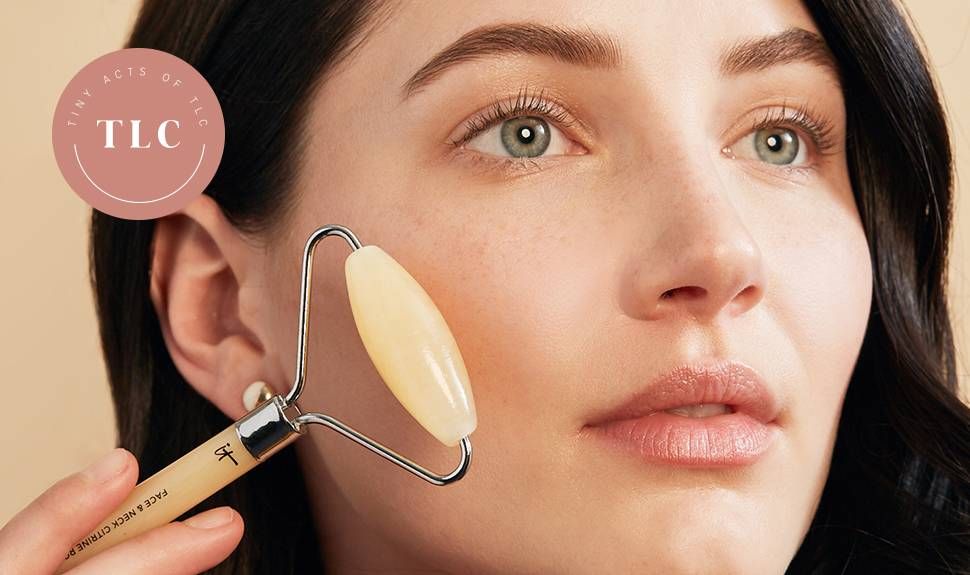
Why a roller can help tension headaches (and why it's not for migraines)
Tension headaches and migraines are different conditions. Tension headaches are caused by muscle tension in the head, neck, and shoulders, and they respond to physical interventions. Migraines are a neurological event, and they don't respond to mechanical tools in the same way.
The roller helps with the tension-headache component that often rides alongside a migraine — the tight temples, the band-like pressure across the forehead, the sore spots at the base of the skull. It does not help with the light sensitivity, the nausea, or the throbbing pain of the migraine itself.
The distinction matters: the roller is a comfort tool for the tension, not a treatment for the migraine. Anyone treating it as the latter is using it wrong.
The 3 pressure points
Point 1: The temple
Where: The soft area on the side of the head, about 1 inch behind the outer corner of the eye and 1 inch above the ear.
How: Use the small head of the roller, hold it against the point for 15–20 seconds, then roll outward toward the ear for 3 slow passes. Zero added pressure.
What it does: The temple is where the temporalis muscle sits, and it's a common tension point. The cool stone + light pressure is a quick "reset" for the muscle.
Point 2: The brow bone
Where: The bony ridge just above the eye, from the inner corner to the outer corner.
How: Use the small head, start at the inner corner, roll outward along the brow bone, 3 slow passes per side. Zero added pressure.
What it does: The brow bone is where the frontalis muscle attaches, and the area is a common tension point for people who squint or concentrate. The cool stone eases the tension in 15–30 seconds.
Point 3: The base of the skull
Where: The bony ridge at the back of the skull, just above the neck, where the neck muscles attach.
How: Use the long head, hold it against the base of the skull for 15–20 seconds, then roll downward along the neck (downward only) for 3 slow passes. Zero added pressure.
What it does: The base of the skull is a major tension point for neck-related headaches, and the cool stone + light pressure is a quick way to ease the tightness.

The 90-second tension-headache routine
- Chill the roller in the fridge for 10 minutes before the session. The cold is the active variable for tension-headache relief.
- Temple: 20 seconds per side, small head, light pressure
- Brow bone: 20 seconds total, small head, light pressure, inner to outer
- Base of skull: 20 seconds, long head, light pressure, downward
- Stop. Total time: 90 seconds. The roller is a quick reset, not a long session.
When the roller helps and when it doesn't
| Situation | Roller helps? | Notes |
|---|---|---|
| Tension headache (band-like pressure) | Yes | The 90-second routine can ease the tightness in 15–30 min |
| Pre-migraine tension (the warning phase) | Yes | Use the roller to ease the tension; take your prescribed medication if a migraine follows |
| Acute migraine (the pain phase) | No | The roller can make the pain worse; skip it |
| Post-migraine recovery | Yes, gently | Light pressure, room-temperature stone, only on the tension points |
| Cluster headache | No | This is a different condition; see a neurologist |
The 3 rules for using a roller on a headache
- Zero added pressure. Headache muscles are already tight; pressing harder makes them tighter. The roller's weight is the only pressure.
- Stop if the pain increases. The roller should feel soothing, not painful. If it makes the headache worse, the roller is not the right tool for this headache.
- Take your medication if prescribed. The roller is a comfort tool; it is not a substitute for the medication your doctor has prescribed. If you have a migraine abortive (sumatriptan, rizatriptan, etc.), take it as directed.
What the roller is not
Three things the roller is not:
- It is not a migraine abortive. If you have a migraine, take your prescribed medication. The roller will not stop the migraine.
- It is not a substitute for a neurologist. If you have frequent migraines (more than 4 per month), see a neurologist. There are preventive treatments that can reduce the frequency; the roller is not one of them.
- It is not a cure for chronic tension headaches. If you have tension headaches more than 15 days a month, see a clinician. The roller is a comfort tool for the occasional tension headache, not a treatment for chronic headache disorders.
Frequently asked questions
Can a jade roller abort a migraine?
No. A migraine is a neurological event, and the roller is a mechanical tool. The roller can ease the tension component, but it does not affect the underlying migraine mechanism. If you have a migraine, take your prescribed medication.
Does the chilled stone make a difference?
Yes. The cold is a known intervention for tension headaches; the cold causes vasoconstriction and a brief reset of the pain signal. A room-temperature stone is less effective for tension-headache relief.
Can I use a roller for sinus headaches?
Yes, with caution. The roller can ease the tension in the cheek and forehead area, but it does not clear sinus congestion. If your sinus headache is caused by a sinus infection, see a clinician; the roller is a comfort layer, not a treatment for the infection.
What about a roller for TMJ pain?
Yes, on the masseter muscle (the jaw muscle, just above the angle of the jaw). Use the long head, 30 seconds per side, light pressure, downward strokes. The roller does not cure TMJ, but it can ease the muscle tension that contributes to TMJ-related headaches.
Is the roller safe to use during pregnancy headaches?
Yes, with the same caveats. Tension headaches during pregnancy are common, and the roller is a safe comfort tool. If you have migraines during pregnancy, talk to your OB about medication; many migraine abortives are not safe in pregnancy, and the roller is not a substitute.
Who should use this routine and who should skip it
Worth using if you have occasional tension headaches, you understand the roller is a comfort tool, and you take your prescribed medication for migraines when needed. The 90-second routine is a useful addition to a headache toolkit, and the cost is zero after the initial roller purchase.
Skip it if you have chronic daily headaches, you're in the acute pain phase of a migraine, you have a sudden severe headache that's different from your usual pattern (call 911 — this can be a sign of something serious), or you're using the roller instead of prescribed medication. The roller is a comfort tool; it is not a treatment.
This article is for general information only and is not medical advice. Migraines and chronic headaches are medical conditions; consult a neurologist for persistent or severe symptoms. The roller is a comfort tool, not a medical device. Some links in this article go to products we independently recommend.