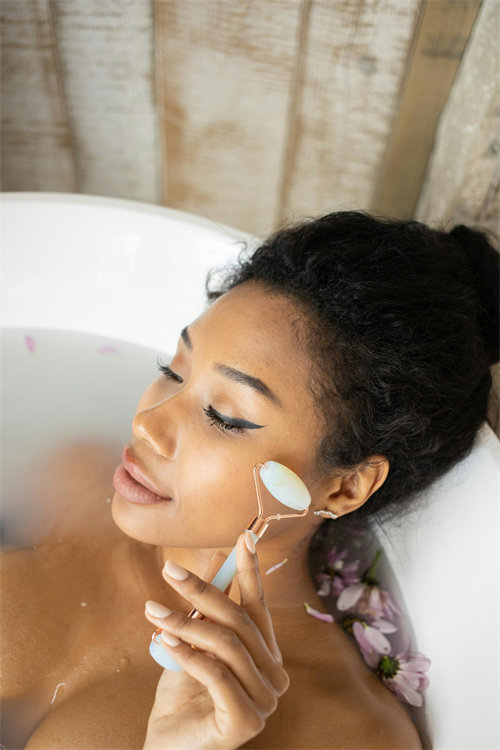
How to Use a Jade Roller on Forehead and Temples: Complete Guide
If you're like most jade roller users, your sessions probably start and end with your cheeks, under-eyes, and jawline. The forehead and temples? Those get a quick once-over at best, if they get any attention at all. That's a real missed opportunity — because these two areas are where tension accumulates most visibly, and where a properly executed jade rolling session can make the biggest difference in how refreshed your whole face looks.
The forehead is one of the largest surface areas on your face, and it's under near-constant low-level tension from squinting at screens, concentrating, and even sleeping on your side. The temples are a pressure point nexus — literally where several facial muscles converge — and they're also one of the most common sites for tension headaches. Rolling these areas well requires a slightly different technique than the rest of the face.
What We'll Cover
Why the Forehead and Temples Need Special Attention
The frontalis muscle — the large, thin muscle that covers the entire forehead — is one of the most-used muscles in the face. Every time you raise your eyebrows, squint at your phone, or furrow your brow in concentration, you're contracting it. Unlike the muscles in your cheeks and jaw, which get some passive movement from talking and eating, the frontalis mostly works in response to eye strain and stress — both of which are chronic problems for most people who spend time on screens.
This chronic low-level tension in the forehead doesn't just cause headaches — it restricts blood flow to the skin of the forehead, which can accelerate the appearance of fine lines and make the skin look duller than it should. Regular jade rolling on the forehead helps by increasing local circulation, releasing superficial muscle tension, and encouraging lymphatic drainage from the upper face.
Forehead Rolling: Step-by-Step Technique
Before you start, make sure your jade roller is clean (here's our step-by-step cleaning guide) and at room temperature or slightly cooled. For forehead work specifically, a room-temperature or lightly chilled roller works better than one that's been in the fridge — the forehead is less sensitive than the under-eye area.
Step 1: Horizontal Strokes Across the Forehead
Using the large end of the jade roller, place it at the center of your forehead, just above your eyebrows. Roll horizontally outward toward your temples, using light to moderate pressure. Keep the stone flat against the skin — if you angle it, you'll get uneven pressure distribution. Make 3-5 passes from center to temple on each side.
Step 2: Vertical Strokes Between the Brows
The area between your eyebrows — the glabella — is where a lot of people hold tension. This is also one of the most neglected areas during rolling. Use the small end of the jade roller. Place the small roller at the top of your nose bridge and roll upward toward your hairline. Do 3-4 slow passes with very light pressure.
Why downward strokes? The lymphatic vessels of the forehead drain laterally toward the temples and downward toward the ears. Rolling upward on the forehead goes against the natural drainage direction. For lymphatic drainage, always go downward and outward — use upward strokes only for pure muscle relaxation.
Temple Rolling: The Right Way to Do It
The temple is a sensitive area that requires a different approach. The temporalis muscle runs through the temple area, and the skin there is thin with relatively little subcutaneous fat. Too much pressure can be uncomfortable; too little and you're not doing much.
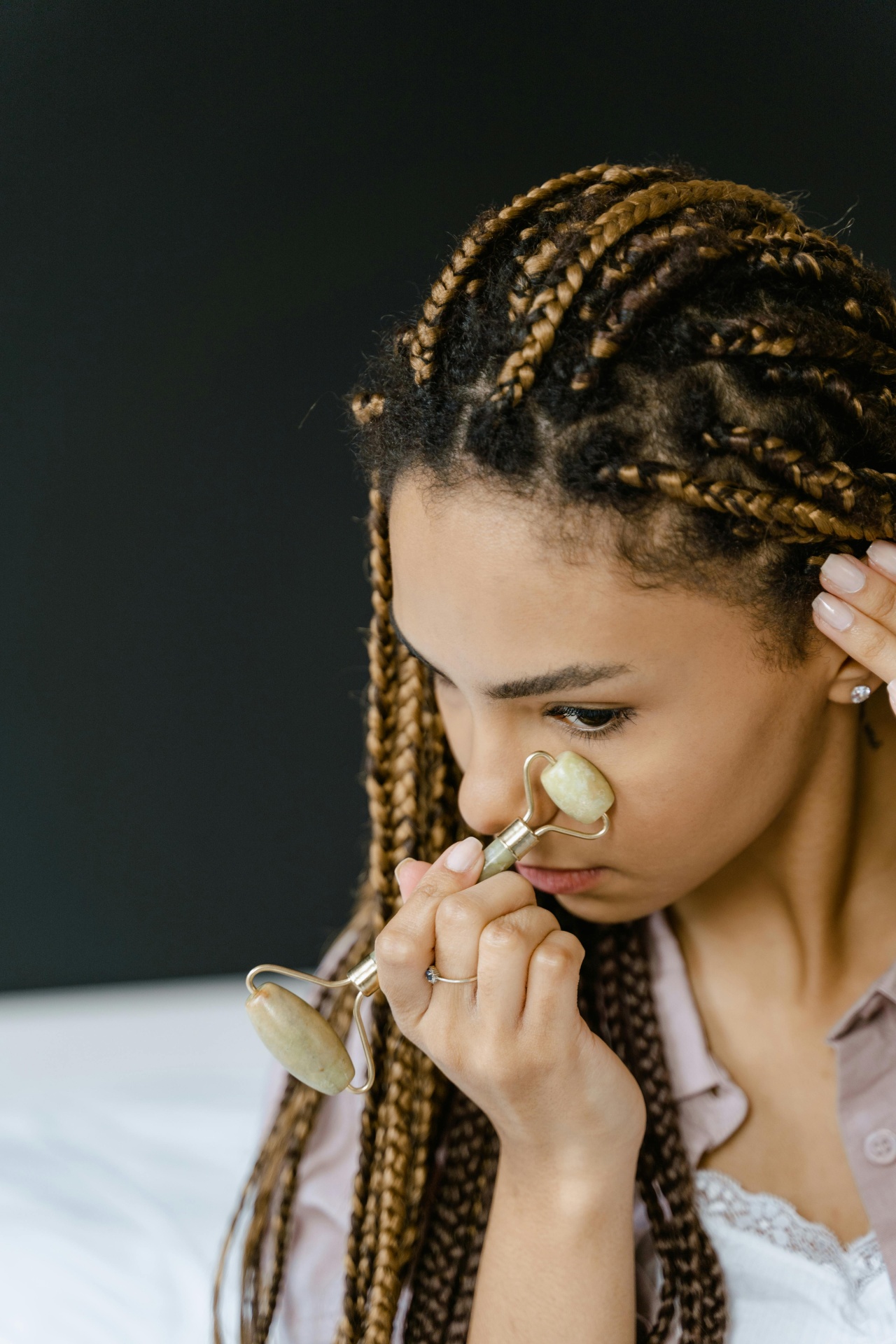
Use the Small End
For temple rolling, always use the small end of the jade roller. The large end covers too much surface area and creates uneven pressure against the curved shape of the temple. The small end lets you apply targeted, controlled pressure.
Moderate Pressure, Circular Motions
Place the small roller on your temple, just in the hollow area at the side of your forehead. Apply light to moderate pressure — enough that you feel gentle contact with the underlying muscle, but no sharp or aching pain. Make 3-4 slow, small circular motions clockwise, then switch to counterclockwise for 3-4 circles.
Using Jade Rolling for Tension Headache Relief
If you get tension headaches — the dull, pressing kind that wrap around to the temples — jade rolling the forehead and temples won't cure the underlying cause, but it can provide meaningful relief for the muscular component.
Research published by the National Institutes of Health notes that manual therapy applied to the head and neck region can reduce perceived pain intensity for tension-type headaches. Jade rolling fits within this framework as a form of gentle manual therapy.
For headache relief specifically: Use a jade roller stored at room temperature — not chilled. Cold can sometimes trigger vasoconstriction that worsens headache symptoms. Room temperature or slightly cool is best for therapeutic temple work.
The Most Common Mistakes People Make
1. Pressing too hard on the forehead. The forehead bone is close to the surface with minimal cushioning. Heavy pressure doesn't release tension — it just compresses tissue against the bone. Light to moderate pressure with smooth, slow strokes works better.
2. Skipping the downward drainage strokes. Many people roll upward because it feels like "lifting" the skin. But lymphatic drainage on the forehead goes down and out — not up.
3. Rolling the temples aggressively. The temple area is delicate. If you finish temple rolling feeling tender or sore, you've used too much pressure.
4. Forgetting the glabella. This is one of the highest-tension spots on the entire face. Use the small end and go slowly — it's worth the extra 30 seconds.
Frequently Asked Questions
Can jade rolling help reduce forehead wrinkles?
Jade rolling increases circulation and releases superficial muscle tension, which can contribute to a smoother appearance. However, it won't eliminate wrinkles — those are primarily caused by collagen loss and repeated muscle contractions over time.
How often should I roll my forehead and temples?
For general maintenance and tension relief, daily or every other day is ideal. For specific headache or tension targeting, once or twice daily without exceeding two sessions to avoid frontalis over-stimulation.
Is it normal for my forehead to feel tender after jade rolling?
Mild tenderness is normal if you held a lot of tension. Sharp tenderness or soreness lasting more than 24 hours means you pressed too hard.
Should I use oil on my forehead before rolling?
Yes — a few drops of lightweight facial oil or serum prevents the roller from dragging on the forehead. Avoid thick occlusive oils that could clog pores on this area.