Jade Rolling During Perimenopause: How Facial Massage Helps When Your Hormones Change
Published on May 16, 2026 | 7 min read
Disclaimer: This article is for general informational purposes only and does not constitute medical advice. Perimenopause is a medical transition that affects every woman differently. Consult your healthcare provider or a board-certified dermatologist before making changes to your skincare routine, especially if you are undergoing hormone replacement therapy or have been diagnosed with a skin condition.
Here's a number that should grab your attention: collagen levels drop by approximately 30% in the first five years of menopause, according to a study published in PubMed. That's not a gradual decline spread across decades — it's a steep cliff that starts during perimenopause, often in a woman's early to mid-40s, long before the final menstrual period.
The visible consequences are the ones everyone talks about: thinning skin, deeper wrinkles, loss of that "bounce" that made your complexion look rested even when you weren't. But what's happening beneath the surface — the slowed circulation, the sluggish lymphatic drainage, the compromised barrier function — doesn't get nearly as much attention. And those are precisely the things a jade roller can actually help with.
No, a jade roller won't replace your collagen. But it can improve the environment your skin lives in — boosting microcirculation, encouraging lymphatic flow, and enhancing product absorption — at a time when your skin needs every bit of help it can get.
In This Article
- What Perimenopause Does to Your Skin (The Version That Actually Matters)
- Why Jade Rolling Is Uniquely Suited to Perimenopausal Skin
- Skin Changes During Perimenopause vs. How Rolling Helps
- A Gentle Routine for Changing Skin
- Jade Rolling and HRT: What You Need to Know
- FAQ: Perimenopause and Jade Rolling
What Perimenopause Does to Your Skin (The Version That Actually Matters)
Estrogen isn't just a reproductive hormone. It's a master regulator of skin health. It stimulates collagen production, maintains skin thickness, regulates oil production, and supports the skin's ability to retain water. When estrogen levels begin their erratic decline during perimenopause, the downstream effects cascade through every layer of the skin:
- Collagen synthesis slows dramatically. The 30% figure often cited covers the post-menopause window, but the process begins years earlier during perimenopause. Thinner dermis means less structural support, which translates to sagging, deeper nasolabial folds, and a general loss of facial volume.
- Microcirculation declines. Estrogen helps regulate blood vessel function in the skin. As levels drop, capillary networks in the dermis become less efficient at delivering oxygen and nutrients to skin cells and removing metabolic waste. The result: dullness, slower healing, and that "tired" look that makeup can't quite cover.
- Lymphatic drainage slows. The lymphatic system doesn't have a pump like the circulatory system has the heart — it relies on muscle movement, manual stimulation, and gravity. As perimenopausal skin becomes less elastic and more fluid-retentive (thanks to shifting estrogen-progesterone ratios), morning puffiness becomes more pronounced and takes longer to resolve.
- Barrier function weakens. Ceramide production declines, transepidermal water loss increases, and skin becomes more reactive to products that never bothered it before. This is why many women in their 40s suddenly find their longtime moisturizer no longer feels "enough."
A 2022 review in the NIH database confirmed that these changes are measurable, consistent, and directly tied to estrogen decline — not simply "aging." That distinction matters because it means the interventions that help are specific, not generic.
Why Jade Rolling Is Uniquely Suited to Perimenopausal Skin
Jade rolling addresses several of the specific physiological changes listed above — not by reversing the hormonal shift (nothing topical can do that), but by compensating for its effects:
- Circulation boost: The mechanical pressure of rolling stimulates vasodilation in the dermal capillary network. Studies on facial massage show a 20-30% increase in localized blood flow during and immediately after treatment. For skin that's receiving less oxygen and fewer nutrients due to declining estrogen, even a modest improvement in microcirculation matters.
- Lymphatic stimulation: The outward-and-downward rolling motion follows the natural drainage pathways of the facial lymphatic system, helping move stagnant interstitial fluid toward the lymph nodes for processing. This is especially relevant for perimenopausal women who notice increased morning puffiness. Our guide to jade roller lymphatic drainage explains this mechanism in more anatomical detail.
- Product penetration: Thinner, drier perimenopausal skin absorbs products differently than the more resilient skin of your 20s and 30s. Rolling serums and moisturizers into the skin can improve penetration of active ingredients — particularly hydrating serums and peptide formulations that support the skin barrier.
- Cooling and calming: Jade's natural thermal properties provide a gentle vasoconstriction effect that reduces redness and visible inflammation. For the increasing number of perimenopausal women who develop rosacea-like symptoms or general skin reactivity, the cooling stone is one of the few tools that doesn't risk further irritation when used correctly.
Skin Changes During Perimenopause vs. How Rolling Helps
| What's Happening to Your Skin | Why It's Happening | How Jade Rolling Can Help |
|---|---|---|
| Increased dryness and flakiness | Declining ceramide production; impaired barrier function | Improved moisturizer penetration; gentle exfoliation from rolling motion |
| Loss of firmness and elasticity | Collagen decline; elastin fragmentation | Increased microcirculation supports fibroblast activity |
| Morning puffiness that lasts longer | Sluggish lymphatic drainage; increased fluid retention | Directed lymphatic stimulation reduces puffiness within minutes |
| Dull, tired-looking complexion | Reduced blood flow to dermal capillaries | 20-30% vasodilation increase during rolling session |
| Increased sensitivity and reactivity | Weakened skin barrier; pH changes | Jade is non-reactive; cooling effect soothes without chemical irritants |
| Thinning skin; more visible veins | Dermal atrophy from collagen and fat loss | Gentle pressure preserves barrier integrity; no aggressive exfoliation |
A Gentle Routine for Changing Skin
Perimenopausal skin needs a different approach than what worked in your 30s. Less pressure, more consistency, and products that prioritize barrier support over aggressive actives:
- Cleanse (30 seconds): Use a cream or oil-based cleanser. Foaming cleansers strip already-compromised skin. Look for ceramides, glycerin, or squalane in the formula. Pat — don't rub — dry.
- Hydrating toner or essence (optional, 15 seconds): A humectant-rich layer (hyaluronic acid, glycerin, beta-glucan) provides a moisture reservoir for the subsequent steps.
- Peptide or barrier-support serum (30 seconds to absorb): This is your investment step. Peptides, growth factors, or ceramide complexes address the structural decline. Apply and let it sit for 30 seconds — don't rush.
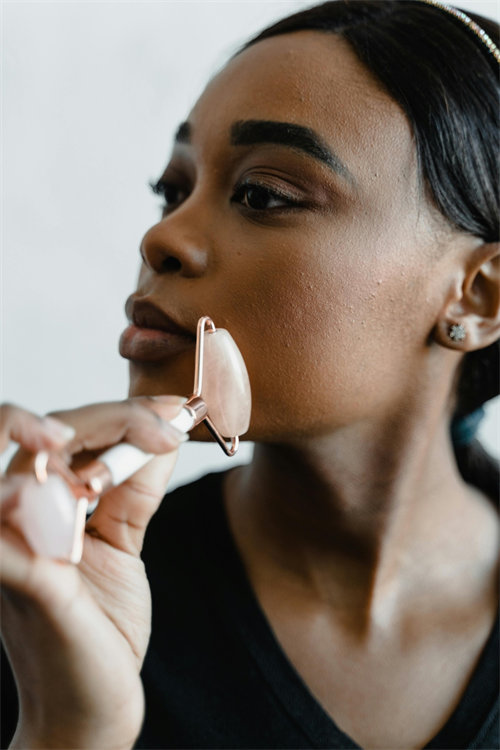
- Moisturizer + jade roller (2-3 minutes): Apply a richer moisturizer than you're used to. Roll outward and upward using lighter pressure than you think you need. Perimenopausal skin is thinner and more fragile — what felt like "medium" pressure at 30 is "aggressive" at 45. Focus on areas where you notice sagging: jawline, nasolabial folds, brow area. Check our neck and decolletage rolling guide — this often-neglected area shows perimenopausal changes earlier than the face.
- Face oil (optional, 30 seconds): A few drops of a non-comedogenic oil (rosehip, squalane, marula) patted over the moisturizer seals everything in. Rolling can be done over the oil layer for extra slip.
- Morning: SPF (non-negotiable, 30 seconds to set): Thinner, less melanin-protected perimenopausal skin is more vulnerable to UV damage. Apply sunscreen as the final step and do not roll over it — our guide on jade roller and SPF timing explains why.
Frequency: 3-4 times per week is the sweet spot for perimenopausal skin. Daily rolling can overstimulate skin that's already in a fragile state. The days between sessions give your skin time to respond to the circulatory boost without chronic mechanical stress on thinning tissue.
Jade Rolling and HRT: What You Need to Know
Hormone replacement therapy can significantly improve skin quality — studies show HRT users have higher collagen density, better hydration, and fewer wrinkles than non-users. If you're on HRT, the good news is that jade rolling is completely compatible. In fact, the improved baseline skin quality from HRT may make rolling more comfortable and effective.
However, one specific caution: some women on HRT develop increased skin sensitivity or a condition called melasma (hormonal hyperpigmentation). If you develop new dark patches, roll with extreme gentleness over those areas — friction can worsen pigmentation in some cases. And as always, discuss any new skincare tool or routine with the provider managing your HRT.
FAQ: Perimenopause and Jade Rolling
I'm 42 and just starting to notice changes. Is it too early to start jade rolling?
Not at all. Perimenopause can begin as early as the mid-30s for some women, and the 40-45 window is when most notice the first visible skin changes. Starting a gentle rolling routine now — when skin still has good baseline collagen levels — is arguably the ideal time. You're supporting circulation and lymphatic function before the steeper declines hit, rather than trying to play catch-up later. Our before and after timeline covers what to expect at each stage.
Can jade rolling help with the hot flashes that affect my face?
A chilled jade roller (fridge temperature, not frozen) can provide temporary relief from the facial flushing that accompanies hot flashes. The cooling effect constricts dilated capillaries, reducing visible redness. However, this is symptom management, not prevention — the roller won't stop hot flashes from occurring. Store it in the fridge, not the freezer, to avoid damaging the stone or shocking already-sensitive skin.
My skin is so dry now — will rolling make it worse?
Dry rolling (on bare, unmoisturized skin) can increase irritation, especially on perimenopausal skin. But rolling with adequate product slip — a moisturizer or face oil — should not worsen dryness. In fact, the improved penetration of your moisturizer from rolling may help your skin retain more hydration. If you're still feeling dry, check that your moisturizer contains barrier-support ingredients like ceramides, fatty acids, and cholesterol — the three components of a healthy lipid barrier — rather than relying solely on humectants.
Your Skin Is Changing — Your Routine Should Too
Perimenopause is the most significant biological transition your skin will undergo since puberty. The skincare routine that worked at 35 won't carry you through 45, and that's not a failure — it's biology. Adding a jade roller to your toolkit isn't about chasing the impossible goal of "anti-aging." It's about giving your skin what it needs in this new chapter: circulation, drainage, gentle stimulation, and better absorption of the products that support your changing barrier.
Start with correct technique, use it consistently but not excessively, and pay attention to what your skin tells you. It's communicating differently now — the trick is learning its new language.