Published on May 19, 2026 | 7 min read
Can You Use a Jade Roller on Your Neck? Safe Areas, Direction & Technique
You're doing your evening skincare routine — rolling your jawline, your cheeks, around your eyes — and you hit the edge of your jaw and wonder: should I keep going down my neck?
If you've been hesitant about rolling below your chin, you're not alone. The neck is one of the most common areas people ask about, and the answer isn't as simple as "yes, go ahead." Done right, jade rolling on your neck can support lymphatic drainage and ease that nagging tension from staring at screens all day. Done wrong, and you could be working against your skin rather than for it.
This guide walks you through exactly where to roll on your neck, which directions matter, how much pressure to use, and what areas to leave alone entirely.
What We'll Cover
- Safe Areas to Use a Jade Roller on Your Neck
- The Upward vs. Downward Debate
- The Jade Roller Neck Face Map
- Step-by-Step: How to Roll Your Neck the Right Way
- Can You Roll Over Lymph Nodes?
- Using a Jade Roller for Neck Tension & Headaches
- Neck Procedures: When to Wait
- What to Never Do on Your Neck
- Keeping Your Roller Clean for Neck Use
Safe Areas to Use a Jade Roller on Your Neck
The short answer: yes, you can use a jade roller on your neck — but only on specific zones and in specific directions.
The skin on your neck is thinner and more sensitive than the skin on your face. It has less subcutaneous fat, which means there's less cushion between your skin and the underlying structures — lymph nodes, glands, blood vessels, and the carotid artery. That changes how you need to approach it compared to your cheeks or forehead.
Here's the general rule of thumb: the front of your neck — the area from your jawline down to your collarbone, bounded by your two collarbones on the sides — is generally safe to roll using downward strokes only. The sides of your neck, where the major blood vessels and lymph nodes run, require more caution or avoidance.
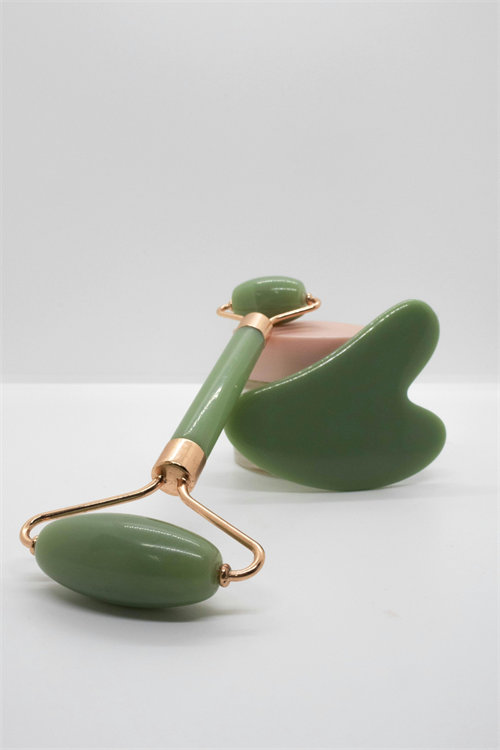
The reason for the downward direction comes down to how jade rolling works scientifically. The stone's cooling effect combined with gentle pressure encourages fluid to move toward the body's natural drainage pathways — and those pathways in the neck drain downward toward the clavicle, not upward toward your chin.
Quick rule: If it doesn't feel comfortable or you're unsure — stop. There's no mandatory technique. The roller is a tool to support your routine, not a medical device.
The Upward vs. Downward Debate (And Why the Answer Matters)
If you've read other jade roller guides, you may have come across sources — including some well-known beauty publications — that recommend rolling upward from your collarbone toward your jaw. That advice isn't wrong in every context, but it doesn't apply to the center-front drainage path of your neck, where the lymphatic vessels all flow in one direction: downward.
Here's the distinction:
- For lymphatic drainage on the center-front neck: downward only. Lymphatic vessels in the anterior neck drain toward the subclavian vein, which sits just above your collarbone. Rolling upward on the center-front works against that flow.
- For skin tightening / circulation on the sides: some practitioners use upward strokes along the sides of the neck (sternocleidomastoid muscle area) — but this is a different mechanism entirely (circulatory massage, not lymphatic drainage), and it requires very light pressure to avoid the carotid artery and jugular vein.
The NovaGlow guide's advice to "Roll upwards from collarbone to jaw" is likely coming from the second context — but it gets conflated with lymphatic drainage advice, which creates confusion. The table below clarifies which direction applies where.
| Neck Zone | Recommended Direction | Mechanism |
|---|---|---|
| Center-front (under-chin to collarbone) | Downward only | Lymphatic drainage — follows gravity and lymphatic flow |
| Sides of neck (along SCM muscle) | Upward OR downward, light pressure only | Circulatory massage only — not lymphatic drainage |
| Behind the ears → down sides | Downward | Bridges face routine into neck drainage |
The Jade Roller Neck Face Map: Roll Zones vs. No-Go Zones
Think of your neck the same way you'd think about your jade roller face map for your face — different zones have different rules.
| Zone | Safe to Roll? | Direction | Notes |
|---|---|---|---|
| Jawline to collarbone (center) | Yes | Downward only | Follows lymphatic drainage path |
| Under-chin area | Gentle only | Outward, then downward | Avoid pressing on the hyoid bone |
| Sides of neck (carotid area) | No or very light | Do not press | Contains major blood vessels — skip this area |
| Thyroid gland area (center, mid-neck) | Avoid | Do not roll | Too much pressure can irritate the gland |
| Behind the ears | Light, short strokes | Downward toward the neck | Connects face routine to neck routine |
| Collarbone / clavicle | Yes, endpoint | Roll along the bone | Final drainage checkpoint |
The center front of your neck is the primary working zone. From the underside of your jaw (just below the chin) down to your collarbone, you're moving with gravity and with your lymphatic system's natural flow. This is where jade rolling may genuinely help with puffiness — especially if you're someone who tends to wake up with a swollen face or a "double chin" that's actually fluid retention rather than fat.
Step-by-Step: How to Roll Your Neck the Right Way
Here's a technique that works well in practice — no fancy moves, just the basics that get the job done without risk.
What you'll need
- A clean jade roller (preferably chilled — more on that below)
- A water-based facial mist or a drop of facial oil (to reduce friction)
- 2–3 minutes
The sequence
- Start behind the ears. Place the roller just behind your ear and make one gentle downward stroke along the side of your neck. This bridges your face routine into your neck routine. Do both sides.
- Move to the under-chin area. With your chin slightly lifted, place the roller at the center point beneath your chin. Roll gently outward toward your ear on each side — like you're guiding fluid away from the center.
- Roll straight down the center. From under the chin, roll straight down toward your collarbone. Use the larger roller end. Apply light, even pressure. Do 3–5 passes.
- Follow the collarbone. Once you reach the collarbone area, roll gently along the bone toward the shoulder. This is where the lymphatic system dumps fluid, so treat it as the endpoint of your drainage path.
- Finish with a cold stroke. If your roller is chilled, one final upward stroke (on the sides only — never upward on the center front) with the cool stone can feel soothing and may temporarily tighten the skin.
About that "chilled" thing: Many people swear by keeping their jade roller in the fridge. The cold can temporarily constrict blood vessels and reduce puffiness — a real, measurable short-term effect. But it won't "tighten" skin permanently. Think of it like a cold compress: the effect fades within an hour or so. Whether you chill yours is a personal preference, not a skincare requirement. We cover the full cold vs. room-temperature debate here.
Can You Roll Over Lymph Nodes?
This is where people get confused — and it's worth being precise about.
Your lymph nodes in the neck are small, bean-shaped structures that filter lymph fluid and help your immune system function. They're part of a larger network — the lymphatic system — that collects excess fluid from between your cells and returns it to the bloodstream via the subclavian veins near your collarbone. The major node groups in the neck region include:
- Submental nodes (under the chin, midline) — drain the chin, lips, and tip of nose
- Submandibular nodes (along the underside of the jaw) — drain the cheeks, lateral nose, and intraoral structures
- Cervical nodes (along the sides and back of the neck, running vertically) — drain the scalp, neck skin, and deeper structures of the head
- Supraclavicular nodes (just above the collarbone) — serve as a final checkpoint before lymph returns to venous circulation
Here's the critical anatomical point that most articles skip: lymphatic vessels don't have their own pump. Unlike blood circulation, which has the heart, lymph relies entirely on muscle movement, gravity, and external pressure to flow. When you roll from your chin downward toward your collarbone, you're applying exactly the kind of external pressure that helps lymph move through these vessels and toward the supraclavicular nodes where it re-enters circulation.
The reason to avoid rolling upward on the center-front neck is that you'd be pushing fluid in the opposite direction of these natural drainage pathways — and since the lymph doesn't flow that way on its own, you're not aiding anything; you may actually cause temporary pooling.
The question of whether you can roll over lymph nodes isn't a yes-or-no — it's about how and where.
On the center-front drainage path (under the chin to collarbone), you're not rolling directly on lymph nodes. The lymph nodes in that zone are relatively sparse. What you're doing is encouraging fluid that has already drained to the nodes to continue moving through the lymphatic vessels toward the subclavian veins near your collarbone.
On the sides of your neck, however, the cervical lymph node chains run vertically along the sternocleidomastoid muscle. These areas are not good candidates for rolling with any meaningful pressure. The pressure from the roller could cause discomfort, and you're not meaningfully aiding drainage by rolling across a lymphatic chain — you're supposed to drain into it, not over it. Very light, gentle strokes along the sides in a downward direction are acceptable.
If you feel a swollen or tender lymph node — a small, pea-sized lump that hurts when you touch it — stop rolling the neck entirely and check with a doctor. Swollen lymph nodes can indicate infection or inflammation that needs medical attention before you resume any massage routine.
If you're interested in the deeper mechanics of lymphatic drainage with jade rolling, our jade roller face map article covers the drainage directions in more detail, including why the face and neck drain differently.
Using a Jade Roller for Neck Tension & Headaches
This is probably the most genuinely useful application of neck rolling that I've come across in practice: tension relief.
If you spend hours at a desk, looking down at a phone, or sitting in front of a screen with poor posture, the muscles at the back and sides of your neck get tight. This tension can radiate upward into your head — causing what's commonly called a tension headache — or pull down into your shoulders.
Here's what a jade roller can and can't do for this:
- Can: Provide a gentle cooling massage that may help muscles relax. The act of rolling — the pressure, the coolness, the slow pace — has a mild relaxation effect. Some people find this genuinely helpful for managing screen-strain headaches.
- Cannot: Replace physical therapy, posture correction, or medical treatment for chronic tension or recurring headaches.
For tension relief, the sides of the neck are actually the area you want to address — but carefully. Use the larger roller end with very light pressure, and roll from behind the ear down toward the clavicle. Do not press hard. The goal is gentle tissue release, not deep-tissue massage.
For a more complete routine targeting tension headaches specifically, the article covers the key pressure points on the face and neck where gentle rolling may provide relief.
Neck Procedures: When to Wait
If you've had any cosmetic or medical procedure on your neck — fillers, laser treatments, Botox in the platysma muscle, a surgical neck lift, or even a moderate chemical peel — your skin needs time to heal before you resume jade rolling.
General guidelines:
- After Botox in the neck (platysma bands): Wait at least 24–48 hours before any massage in that area. The toxin needs time to settle into the muscle; mechanical manipulation could theoretically diffuse it into unintended areas. After the initial waiting period, very gentle rolling is fine — but check with your injector first.
- After neck fillers: Wait at least 1–2 weeks. Pressing on freshly placed filler can shift it, particularly in the submental area (under the chin).
- After laser or peel: Wait until the skin is fully healed — typically 1–4 weeks depending on the aggressiveness of the treatment. Listen to your provider, not a generic guide.
- After neck lift surgery: Follow your surgeon's protocol exactly. Most will have you avoid any pressure on the neck for 4–6 weeks minimum.
Disclaimer: This article is for general informational purposes only and does not constitute professional medical or aesthetic advice. For specific decisions related to cosmetic procedures, please consult a board-certified dermatologist or plastic surgeon.
What to Never Do on Your Neck
A short list of things that sound obvious but are worth stating plainly:
- Never roll upward on the center front of your neck. You're working against your lymphatic system and against gravity. Upward strokes on the neck serve no functional purpose and could cause fluid to pool.
- Never press hard. The structures under the skin of your neck are more exposed than on your face. Heavy pressure on the thyroid, trachea, or carotid artery is unnecessary and potentially harmful.
- Never roll over active acne or open wounds. If you have a cyst, boil, or any open sore on your neck, skip that area entirely. Rolling can spread bacteria.
- Never use on a cracked or damaged jade roller. A chipped stone can catch on skin and cause cuts. Inspect your roller before each use.
- Don't roll if you have a skin infection. This applies to the face too, but neck lymph nodes drain directly into the immune system, so the stakes are slightly higher.
For a broader look at safety considerations including who should exercise extra caution, our jade roller side effects guide covers the full safety picture.
Keeping Your Jade Roller Clean for Neck Use
One practical thing that doesn't get enough attention: the neck is closer to your body's drainage system than your face is. If you're rolling your neck after doing your face, there's a higher chance you're moving bacteria from the face toward neck lymph nodes.
This isn't cause for alarm — it's just a reason to be diligent about cleaning your roller:
- Wash the roller with warm water and a gentle, fragrance-free soap after every use.
- Pat dry with a clean towel — never leave it sitting in water.
- Store in a clean, dry place (a breathable pouch is ideal).
- If you're sick (cold, flu, throat infection), clean the roller more frequently and consider pausing neck rolling until you're recovered.
For the full cleaning protocol including deep cleaning and disinfection, see our step-by-step jade roller cleaning guide.
Frequently Asked Questions
Can I use my jade roller on my throat?
You can roll gently on the center front of your throat (the area below your chin and above your collarbone, in the midline) using downward strokes only. Avoid the thyroid gland — the rounded bump in the center of your neck — and never press hard in this area.
Does jade rolling on the neck actually reduce a double chin?
It depends on what's causing the appearance. If the look of a "double chin" is partly fluid retention, jade rolling may help temporarily by encouraging lymphatic drainage. If it's fat tissue or skin laxity, rolling won't make a meaningful difference. There's no evidence that jade rolling reduces fat.
How often should I roll my neck?
Once or twice daily is typical — the same frequency as your facial routine. Daily use is generally safe for healthy skin. If you experience any redness, soreness, or discomfort, reduce frequency or stop entirely.
Can I use a gua sha tool on my neck?
Yes, with similar rules to jade rolling: downward strokes on the center, light pressure, avoid the sides where major vessels run. Gua sha may provide slightly more pronounced tissue release due to the flatter surface, but the same safety principles apply.
Want to see results? We tracked daily jade roller use for 30 days and documented what actually changed — and what didn't. Worth reading before you start any new routine.