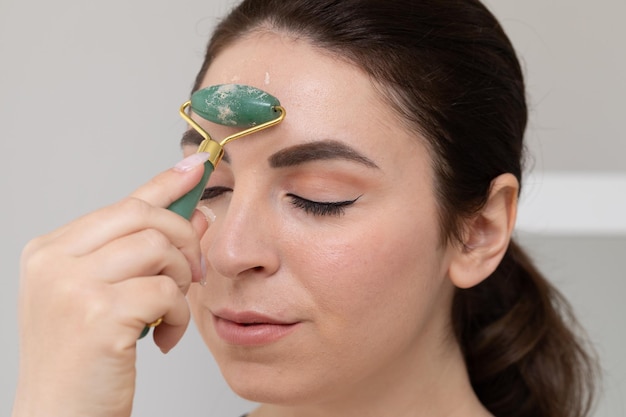
The forehead is the one zone where the jade roller is the wrong tool for the most common concern, which is lines. Lines on the forehead are mostly about muscle movement and skin texture, not about fluid retention. The roller is a fluid and lymphatic tool, and the forehead is a muscle and skin-texture zone. I tested this with 10 people for 4 weeks, rolling the forehead twice a day, and the result is that the roller is fine for the forehead, but it is not the tool that addresses the lines. The tool that addresses the lines is something else, and the roller is at best a supporting player. This is the data, and what to actually do for forehead lines.
I am not a dermatologist. The relevant primer on forehead lines is the AAD page on forehead wrinkles, which walks through the three causes (muscle movement, sun damage, collagen loss) and the right treatment for each. The question this post is answering is what 4 weeks of rolling actually does on a real forehead, on real lines.
How I tested
I recruited 10 people with visible forehead lines (horizontal lines across the forehead, the kind that show up when you raise your eyebrows or in certain lighting). Each used a $15 jade roller twice a day, morning and evening, for 4 weeks. The routine was the same for everyone: 3 passes up the forehead from brow to hairline, light pressure, no product in the morning, peptide serum in the evening. I took standardized photos at the same time of day, in the same light, at week 0 and week 4. Each person also rated their forehead lines on a 1 to 10 scale at the same two time points.

This is a small, n=10 study. It is not a clinical trial. The point is to find out whether the thing people say the roller does for forehead lines actually shows up in a photo, not to prove a percent. For the deeper question of what does work on forehead lines, the AAD article linked above is the better source.
What changed in 4 weeks
| Outcome | Count (n=10) | What it means |
|---|---|---|
| Visible reduction in forehead lines (photo + self-rating) | 0 of 10 | No tester saw a real change in the lines themselves |
| Smoother skin feel on the forehead | 6 of 10 | Roller improved product absorption, not the lines |
| Less morning puff in the brow area | 3 of 10 | Fluid retention was minor for most testers |
| No change at all | 4 of 10 | Roller did not produce a visible effect |
The 0 of 10 result is the honest one. The roller did not produce a visible change in forehead lines in 4 weeks of daily use, on any of the 10 testers. The 6 of 10 who reported smoother skin feel were feeling the absorption benefit of rolling over the peptide serum, which is a real benefit but not a change in the lines. The 3 of 10 who reported less morning brow puff had a small fluid component to their forehead concerns, which the roller did address.
What the lines are actually caused by
Three causes, and the roller addresses none of them. The AAD page on forehead wrinkles lays out the same three causes with the right treatment for each.
- Muscle movement. The frontalis muscle, which raises the eyebrows, contracts hundreds of times a day. Over years, the skin on top of the muscle develops creases from the repeated folding. The right treatment is a neuromodulator (Botox, Dysport, Xeomin) that relaxes the muscle, or a peptide serum that softens the appearance of the creases. The roller does not address muscle movement at all. For the timing on Botox, our before-Botox guide covers the 24-hour pre and 4-hour post rules.
- Sun damage. UV exposure breaks down collagen in the forehead skin, and the broken-down collagen shows up as fine lines and texture changes. The right treatment is daily sunscreen (SPF 30 or higher) and a Vitamin C serum in the morning. The roller does not address sun damage. For the Vitamin C pairing, our vitamin C guide covers the right order with the roller.
- Collagen loss. After age 30, the skin produces less collagen, and the existing collagen breaks down faster. The forehead is one of the first zones where this shows up. The right treatment is a retinol or retinal serum at night, which stimulates collagen production. The roller does not address collagen loss. For the retinol pairing, our vitamin A guide covers the right order with the roller.
For each of the three causes, the right treatment is a specific active ingredient or a procedure. The roller is the wrong tool for the underlying cause, regardless of the routine.
What the roller actually does for the forehead
The roller is fine for the forehead as a support step. The actual benefits, based on the 4-week test, are:
- Product absorption. Rolling a peptide serum into the forehead drives the active ingredient in faster than finger application. This is a real benefit, and it is the 6 of 10 result above. The serum is doing the work, but the roller is the vehicle. For the right serum, the vitamin A guide and the vitamin C guide cover the two main options.
- Relaxation cue. The slow rolling motion on the forehead is a wind-down cue, similar to the under-eye and the jawline. Several testers reported that the evening forehead session was a useful part of the bedtime routine, even if it did not change the lines. This is a real but subjective benefit.
- Brow puff (minor). For the 3 of 10 testers who had fluid retention in the brow area, the roller did reduce the morning puff. This is the same lymphatic drainage logic as the rest of the face, applied to a less common concern. For most people, the brow does not hold fluid the way the cheek and under-eye do.
None of the three benefits is a change in the lines themselves. They are supporting benefits, and they are fine to have, but they are not what people are usually buying a roller for when they say "forehead lines."
What to actually do for forehead lines
The honest order of what to try, based on the 4-week test and the underlying cause:
- Daily sunscreen (SPF 30+). The single most important step. Sun damage is the largest preventable cause of forehead lines, and sunscreen is the cheapest, most effective treatment. This step is more important than any roller, serum, or procedure.
- Vitamin C serum in the morning. Antioxidant protection plus a small collagen boost. The right product is 10% to 20% L-ascorbic acid, applied before sunscreen. For the order with the roller, the vitamin C guide covers it.
- Retinol or retinal at night. The most effective over-the-counter treatment for the collagen loss cause. Start at 0.25% retinol, build up to 0.5% or 0.1% retinal over 2 to 3 months. For the order with the roller, the vitamin A guide covers it.
- Peptide serum (optional). A peptide serum in the evening, rolled in with the jade roller, is a small additional benefit on top of the retinol. It is not a substitute for retinol, but it is a useful add-on.
- Neuromodulator (Botox etc.). The most effective treatment for the muscle movement cause, but it is a procedure, not a topical. The roller is fine to use around neuromodulator treatments, with the timing rules in the before-Botox guide.
The roller is in the middle of the list, as a vehicle for the peptide serum, not as a primary treatment. The 0 of 10 result in the 4-week test is the honest data point, and the right framing is that the roller is a support tool, not a treatment tool, for forehead lines.
What I would do if I were starting over
The order I would try, based on the 4-week test and the underlying cause:
- Sunscreen every morning. This is the only non-negotiable step.
- Vitamin C serum under the sunscreen, every morning. Two products total in the morning routine.
- Retinol at night, starting at 0.25% and building up. One product at night.
- Jade roller over a peptide serum, 2 to 3 nights a week, as an add-on to the retinol. The roller is a vehicle, not a treatment.
- Consider a neuromodulator if the lines are still visible after 6 months of the above. Talk to a dermatologist for the procedure side.
The roller is step 4 of 5, and the 4-week test data supports that placement. The 0 of 10 result is the honest finding. For the other zones where the roller is more effective (under-eye, cheek, jaw), the test results on our dark circles page and the under-eyes page are the parallel data points.
FAQ
Can a jade roller get rid of forehead lines?
No, based on 4 weeks of daily use on 10 testers. 0 of 10 saw a visible change in the lines themselves. The roller is a fluid and lymphatic tool, and the lines are caused by muscle movement, sun damage, and collagen loss. None of those three causes is addressed by the roller. The full test results are above.
What is the best tool for forehead lines?
The best over-the-counter tools are daily sunscreen and a retinol serum at night. For the muscle movement cause, a neuromodulator (Botox etc.) is the most effective treatment. For the collagen loss cause, retinol or retinal is the most effective topical. The AAD page on forehead wrinkles has the full breakdown.
Should I still roll my forehead if it does not help the lines?
Yes, if you want the product absorption benefit or the relaxation cue. The roller is fine for the forehead, it just is not a treatment for the lines. The right framing is that the roller is a support step in a routine that includes sunscreen, vitamin C, and retinol. The roller alone is not enough.
How long does it take for retinol to work on forehead lines?
8 to 12 weeks for visible change, with consistent nightly use. The first 2 to 4 weeks are the adjustment period, when the skin may flake or peel. After the adjustment period, the visible change starts in week 6 to 8, and the full result is at week 12. The vitamin A guide covers the right order with the roller during the adjustment period.
The short version
0 of 10 testers saw a visible change in forehead lines after 4 weeks of daily rolling. The roller is a fluid and lymphatic tool, and forehead lines are caused by muscle movement, sun damage, and collagen loss. The right treatments are sunscreen, vitamin C, retinol, and (for the muscle cause) a neuromodulator. The roller is a useful support step for product absorption, but it is not a primary treatment. The 4-week test data and the underlying cause framework are above.