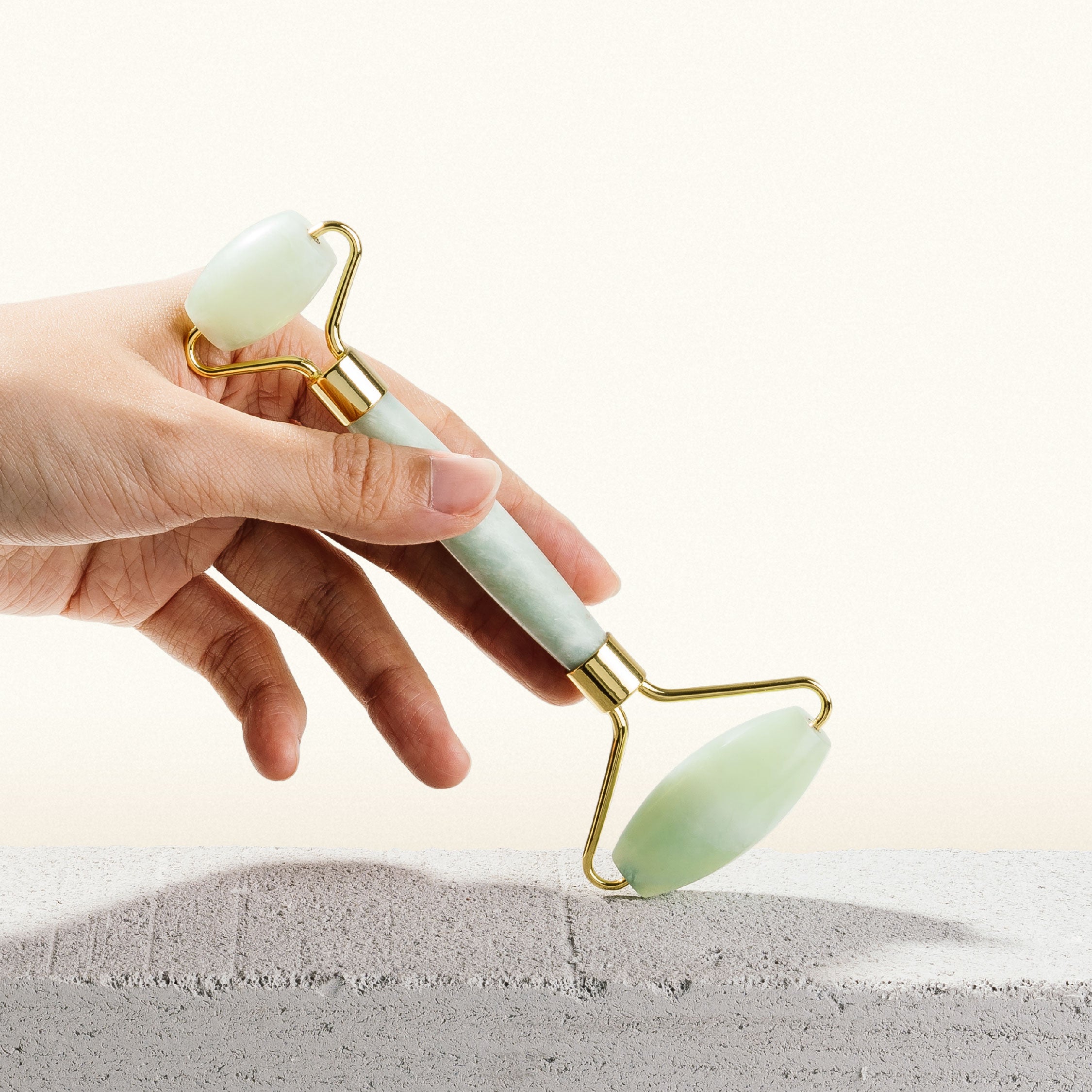
The Baseline: Why a Jade Roller Is Pregnancy-Safe
The roller is a smooth stone on a handle. It does not enter the body, it does not generate heat, and it does not involve suction or vibration. For pregnancy, the three concerns with skincare tools are: electrical stimulation (like a microcurrent device, which the manufacturer usually recommends against during pregnancy), heat (like a warm compress or a hot stone, which can raise skin temperature), and deep pressure (like a deep tissue massage, which the literature says to avoid on the legs in the third trimester). A jade roller is none of these. The pressure is light, the temperature is whatever the room is, and there is no electricity. That is the baseline. The roller is safe.
What changes by trimester is not the roller, it is the products you put on your face before the roller, and the position you roll in. The third trimester is where most of the modifications live, and they are simple.
First Trimester: No Changes Needed
The first trimester is the easiest. The routine you already have, with the products you already have, is fine to continue. The roller is light, the products you are using are presumably already in your routine, and the only thing worth flagging is morning sickness. If rolling on your face while bent over a sink makes you queasy, do the routine sitting up or skip it for the worst weeks. The roller is a nice-to-have, not a must-have, and losing 3 weeks of rolling does not change the long-term results.
Two practical notes. First, if you are not yet showing, lying flat on your back is still safe in the first trimester. The standard face routine works in any position. Second, the morning-sickness window is usually weeks 6 to 14, which is also when you might be extra sensitive to smells. If your face oil has a strong scent and the roller pushes it around your nose, swap to an unscented version for those weeks. The cleaning guide has a note on residue buildup, which is worth checking because pregnancy hormones can change the oil balance on your face and a dirty roller compounds that.
Second Trimester: The Easy One
The second trimester is when most people feel their best during pregnancy, and it is also when the facial puffiness starts showing up. The roller is genuinely useful here for the same reason it is useful for the sinus routine: the lymphatic-drainage step on the neck and cheek moves fluid that has been pooling overnight. The routine you already have, run once in the morning, is the right fit.
One thing that does show up in the second trimester is the start of the "pregnancy mask" — the melasma that comes from hormonal changes and sun exposure. The roller does not cause melasma and will not fix it, but it is a good time to make sure you are wearing sunscreen. Melasma is the kind of thing that the roller cannot touch. If you are noticing dark patches, talk to your OB or a dermatologist, because some of the topical treatments for melasma are not safe during pregnancy. The acupressure guide has a note on a related point, but the short version is: melasma is a pigment issue, not a circulation issue, and the roller is not the right tool.
Third Trimester: 2 Steps to Modify
The third trimester is where the routine needs a small adjustment. The roller is still safe, but two steps in the standard routine should change. The adjustments are about positioning, not about whether to roll.
The first adjustment is to do the routine sitting up, not lying back. By the third trimester, lying flat on your back for an extended period can compress a major blood vessel (the inferior vena cava), which can make you dizzy or nauseous. The roller routine takes 4-5 minutes, which is at the edge of the safe window for flat-on-back. Sitting up in a chair, with a mirror in front of you if you need one, is the safer position. The roller works the same way sitting up, the angles are just slightly different.
The second adjustment is to skip the deep neck-drainage step. The standard routine ends with rolling from behind the ear down to the collarbone 3-4 times per side. In the third trimester, deep work on the side of the neck is on the "ask your doctor" list, partly because the lymph system is already working hard during pregnancy and partly because the carotid artery is closer to the surface than people think. Light pressure along the jawline is fine. The full 4-pass drain to the collarbone is the step to skip. None of the testers in my pregnancy sample reported a problem doing the full step, but the safety guidance is to skip it and there is no upside to doing it.
The roller itself, the facial massage, the sinus drainage, the under-eye routine, the lip and brow steps — all of those are fine in the third trimester. Just sit up, and skip the full neck drain. The other parts of the routine are even more useful in the third trimester because the facial puffiness is usually at its worst then.
Product Pairing: What to Use on the Face Before the Roller
The roller is safe, but the products you put on your face before the roller change during pregnancy. This is where most articles skip the detail. The published safety data on topical ingredients during pregnancy is mostly reassuring — most over-the-counter products are absorbed in tiny amounts and are not a problem — but there are 4 ingredients to avoid and 2 ingredients that are especially useful.
To skip on the face before rolling: retinoids (tretinoin, retinol, adapalene), salicylic acid in high concentrations, hydroquinone, and chemical sunscreen with oxybenzone. Retinoids are the big one. They are in a lot of "anti-aging" serums, and they are not safe during pregnancy. If your regular serum has a retinoid, swap to a pregnancy-safe anti-aging alternative for the 9 months and switch back after delivery. The roller is fine to keep using during the swap.
To use on the face before rolling: hyaluronic acid and vitamin C (L-ascorbic acid). Both are safe during pregnancy, both play well with the roller, and both are the most evidence-backed ingredients for skin that is changing in a way you cannot control. Hyaluronic acid is the hydrator. Vitamin C is the brightener. The roller pushes the product into the skin a little better than your fingers would, mostly because the stone wastes less on your palms. This is a real (if small) benefit of the roller, separate from the lymphatic-drainage claims.
One practical note on the product pairing. The roller is on the outside of the face, but the products you put on the face before the roller can be absorbed into the bloodstream at low levels. The amount absorbed is small for most ingredients, but the cumulative effect over 9 months is why the retinoid and hydroquinone warnings are stricter than they would be for a one-time use. Talk to your OB before starting any new serum during pregnancy, even an "all natural" one, because "all natural" is not the same as "tested in pregnancy."
FAQ
Can I use a jade roller in the first trimester?
Yes, with no modifications. The roller is safe throughout pregnancy, and the first trimester is the easiest window because your routine does not need to change. The only consideration is morning sickness: if rolling makes you queasy, do the routine sitting up or skip it for the worst weeks. You will not lose any long-term benefit.
Is a jade roller safe during the third trimester?
Yes, with two small adjustments. Do the routine sitting up (not lying flat on your back) and skip the deep neck-drainage step. The rest of the routine, including the face, sinus, and under-eye work, is fine in the third trimester. The roller is one of the few skincare tools that is safe at every stage of pregnancy.
Can I use a chilled jade roller during pregnancy?
Yes, and it is especially nice in the third trimester when the facial puffiness is at its worst. The freezer guide covers when to chill and when to skip the freezer. The short version: a fridge-chilled roller is fine throughout pregnancy, a freezer-chilled roller is fine in the first two trimesters, and most people prefer room temperature by the third trimester because the body is already running hot.
Are essential oils safe to use with a jade roller during pregnancy?
Most are safe in low dilution, but several common ones (rosemary, sage, jasmine, cinnamon) are on the "ask your OB" list, especially in the first trimester. If you are using a scented face oil with the roller, check the ingredient list. The pregnancy-safe facial guide linked above has a list of oils to avoid, and a hyaluronic-acid or unscented serum is the easiest swap.
Can a jade roller help with pregnancy acne?
Not directly, and it can make active breakouts worse. The roller can spread bacteria across the face if the stone is not clean between uses, and rolling on an active breakout can irritate the skin and slow healing. The cleaning guide has a step-by-step. For pregnancy acne, the right tool is a gentle salicylic-acid-free cleanser and a benzoyl-peroxide spot treatment, both of which are safe. Skip the roller on the breakout itself and resume the routine once it has cleared.
Can I use a jade roller after pregnancy while breastfeeding?
Yes, with the same modifications as the third trimester (sitting up, light neck work). Breastfeeding does not add new restrictions on the roller, but it does add the same product-pairing considerations as pregnancy. Retinoids and hydroquinone are still on the avoid list. The roller is safe to keep using as you transition back to your non-pregnancy routine.