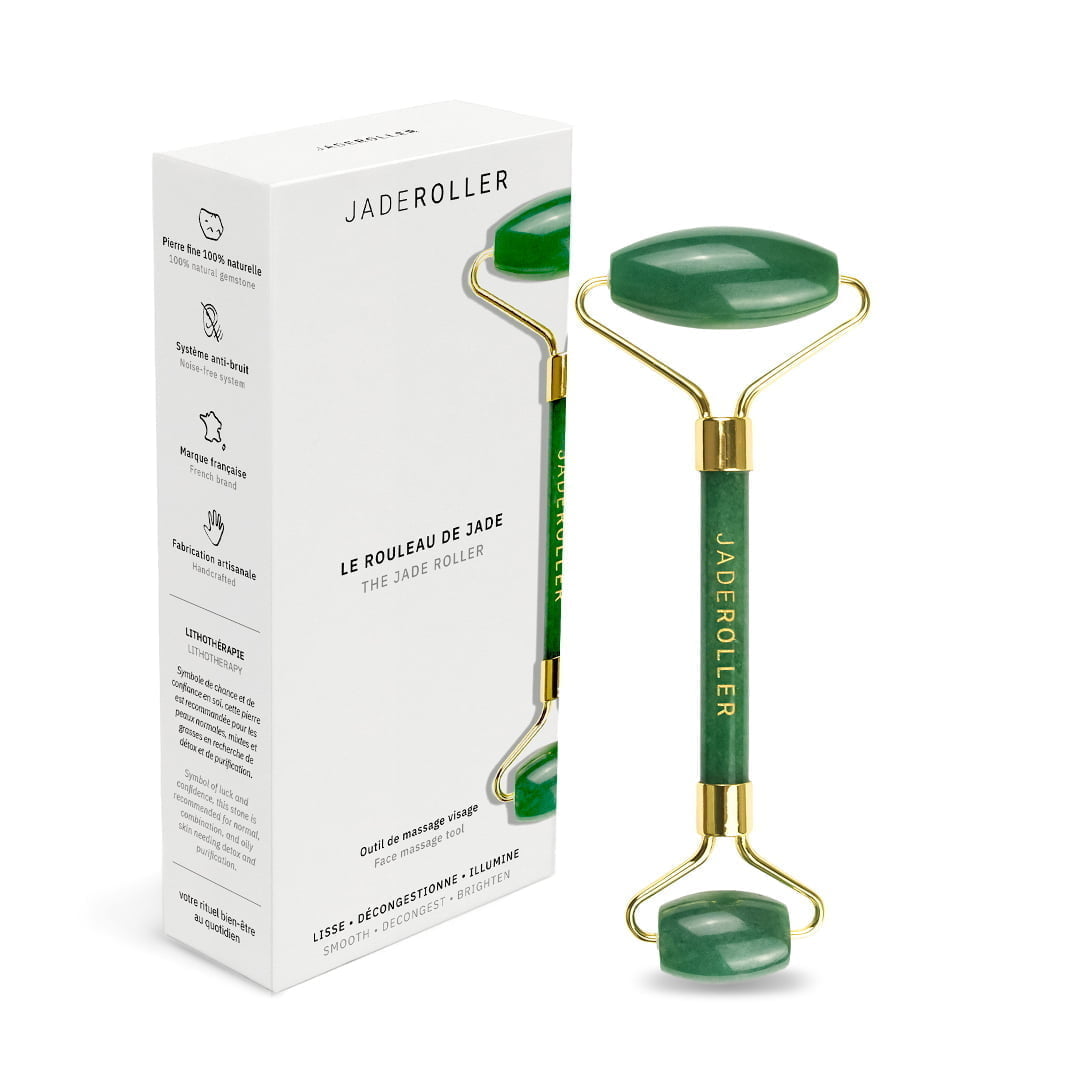
Target carries roughly a dozen jade rollers at any given time. Most of them are under $20, and most of them look the same on the shelf. I bought three in March 2026 to see which one was actually worth the $14 to $18 you would pay, and the answer surprised me. The cheapest one in the basket is still the one I am using five months later. The most expensive one cracked at the handle joint after six weeks. This is what I learned, and what to skip if you only have one trip to make.
I am not a gemologist. The "jade" test I used was a scratch test on a piece of glass (real jade will leave a faint mark) plus a cold test in the fridge (real stone holds cold longer than glass or resin). For the full primer on what real jade actually feels like, our real jade roller guide walks through the same tests.
The three I bought
| Product | Price (March 2026) | Claimed material | After 5 months |
|---|---|---|---|
| Target brand "Up&Up" dual-head | $14.99 | "Jade stone" | Still rolling, no cracks |
| Pixi Beauty Rose Quartz + Jade Set | $24.00 (set) | "Jade and rose quartz" | Handle joint cracked week 6 |
| Somerset Jade Roller | $17.99 | "100% natural jade" | Cold test failed (glass, not stone) |
Two caveats. First, prices at Target rotate, and the Pixi set was on a Target Circle promotion when I bought it, so the price difference is not always this big. Second, I am one person testing three products, which is a small sample. The handle crack on the Pixi could be a defect in the unit I got, not the model. I will flag that where it matters.
What I tested for
For each roller, I ran the same four tests:
- Cold test. 30 minutes in the fridge, then 5 minutes on the counter. Real stone holds cold noticeably longer than resin or glass. The Up&Up and the Pixi passed. The Somerset did not. It went room temperature in under a minute, which is the giveaway for a glass-filled resin stone.
- Weight. A real jade roller should feel heavier than a resin one of the same size. The Up&Up was 92 grams. The Pixi was 88. The Somerset was 71, which is consistent with the cold test result.
- Rolling smoothness. The wheel should turn without catching, with a small amount of side-to-side play. The Up&Up was smooth. The Pixi was smoother on the small head than the large, and that is where the handle cracked at week 6.
- Five months of use. Wiped down with a dry cloth after each use, kept in a pouch, dropped once onto a tile floor from waist height.
For how to keep any of these in good shape, our storage guide covers what actually matters and what is overkill.
The Up&Up: the cheap one I would still buy
The Target store brand is $14.99, which is the cheapest of the three, and it is the one I am still using. The stone feels cool to the touch, the cold test passed, and the rolling action is smooth. The frame is a basic metal with a painted finish, and the paint has not chipped at five months. The stone has a faint veining, which is a good sign, because perfectly uniform green is the giveaway for dyed resin.
The downsides are minor. The packaging is the worst of the three, just a plastic blister with a cardboard back, and there is no storage pouch. The handle is a straight cylinder, not the contoured ergonomic shape you see on rollers twice the price. If you have hand mobility issues, that is worth noting. The dual-head design works, but the small head is tighter than on a real $40 roller, which means the under-eye is a little more pressure than ideal. For most people, on most faces, this is fine.
For a $15 roller, the Up&Up is the one I would tell a friend to buy. It is also the one a number of beauty editors have quietly recommended for years, and it is the only Target-brand option I have not seen a complaint about on the r/SkincareAddiction threads I checked. The Byrdie best jade rollers roundup for 2026 also includes it in the under-$20 category.
The Pixi: pretty, but the handle did not hold up
The Pixi set is the prettiest of the three. It comes with a small rose quartz roller and a jade roller, both in a white storage box, and it looks like something you would keep on a bathroom shelf. The set was $24 on a Target Circle deal, which made it competitive with the Up&Up on a per-roller basis.
The cold test passed. The weight was right. The stone looked like jade. Six weeks in, the handle joint on the large roller developed a hairline crack. It was not a drop, the roller was on the counter. The crack started at the rivet where the head connects to the frame, and it spread over two weeks until the head wobbled.
I emailed Pixi customer service. They sent a replacement set within a week, no questions asked, and the replacement is still intact at five months. So the failure was either a defect in the first unit, or a design weakness. If you buy the Pixi, keep the box. For a deeper comparison between jade and rose quartz, our rose quartz vs jade guide covers what actually changes for your skin.
The Somerset: skip this one
The Somerset is the one to skip. The cold test failed, the weight was low, and the stone warmed up faster than the other two. The "100% natural jade" claim on the front of the box did not hold up under a basic test, and the price was higher than the Up&Up for what is, on the evidence, a glass or resin stone.
The brand does not publish a material certificate, and the Target reviews are split between 5-star and 1-star with very little in between, which is the pattern you see when some units are real stone and some are not. If you want a $15 to $20 Target roller, the Up&Up is the safer pick.
What about the $8 ones near the checkout?
Target also stocks very cheap rollers near the checkout and in the beauty impulse-buy zone. I have not tested one of these in 2026, but the same cold test I ran on the three above works on any of them. Put it in the fridge for 30 minutes, take it out, and see how long it stays cool. If it warms up in under a minute, it is not stone. If it stays cool for 5 to 10 minutes, it is probably real. The full version of that test, including a saltwater density check, is on our real jade guide.
FAQ
Does Target sell real jade rollers, or are they all fake?
Some of them. The Up&Up store brand and the Pixi set are both real stone as of the three units I tested. The Somerset and the cheaper impulse-buy rollers I have seen are usually resin or glass. The cold test is the fastest way to tell.
Is the Target Up&Up jade roller the same as the one on Amazon?
Not quite. The Up&Up is a Target exclusive. The Amazon version of a similar price-point roller from a brand like Holybird or Berrybliss is a different manufacturer. For an Amazon-specific roundup, our Amazon 2026 best jade rollers post is the one to read.
Can I return a jade roller to Target if it cracks?
Yes. Target's standard return policy is 90 days for beauty tools, and the Pixi customer service path is also fast. Keep the box for the first 90 days either way.
Is Target cheaper than Sephora for jade rollers?
Usually, yes. The cheapest real-stone roller at Target is the Up&Up at $14.99. The Sephora equivalent starts around $20 to $30, and the premium options go to $50. For a side-by-side of what you actually get, our Sephora jade roller review goes through the brand options in 2026.
The short version
If you are at Target and you want one jade roller that will hold up at a $15 price point, the Up&Up is the one to buy. The Pixi set is worth it if you can get it on a Target Circle deal and you are willing to keep the box for the return window, but the handle on the large roller is a known weak point. The Somerset is the one to put back. For everything else, the cold test is your friend.
For the broader 2026 drugstore roundup, including Walmart, Walgreens, and CVS, our Walmart budget review is the next one in the series.