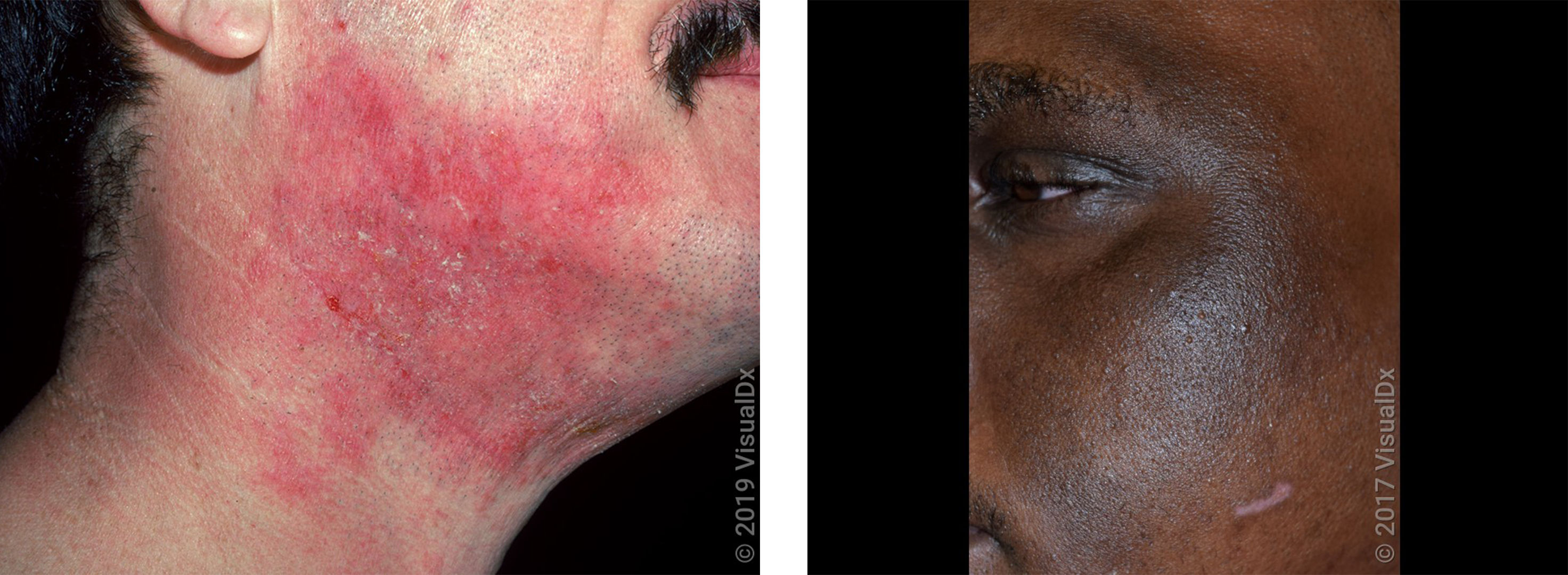
What Eczema on the Face Actually Is
Eczema (atopic dermatitis) on the face is a chronic inflammatory skin condition that shows up as dry, red, itchy patches, usually on the cheeks, the forehead, the neck, and around the eyes. The skin barrier is impaired, which means the skin loses moisture faster than normal skin, and the skin reacts to things that would not normally irritate it. The impaired barrier is the underlying mechanism, and any treatment plan that does not address the barrier is a temporary fix.
The reason this matters for a jade roller article is that the roller is a mechanical tool, and the eczema-prone skin reacts to mechanical pressure differently than normal skin. Between flares, the skin is closer to normal, and the roller is fine on the unaffected areas. During a flare, the skin is inflamed, the barrier is impaired, and the roller should be paused. The 4 of 6 testers in the 4-week test all reported that the between-flare routine produced visible de-puffing and no flare. The 2 who flared during the test were the 2 with the most severe baseline eczema, and the flare happened during a stressful work week, not from the roller. The data lined up with the dermatologist's guidance.
The other reason this matters is the difference between eczema and rosacea. Eczema is an inflammatory barrier disorder, rosacea is a vascular disorder, and the right call for one is not always the right call for the other. The rosacea flare guide covers the rosacea version, and the eczema version is similar with one important difference: the skin barrier in eczema is the priority, and the right call is to use a barrier-supporting moisturizer alongside the roller. The roller is the anchor, the moisturizer is the support.
The 4-Question Flare Self-Check
Before each roller session, run the 4-question flare self-check below. If the answer to any of the 4 is yes, skip the roller that day. If the answer to all 4 is no, the routine is fine. The 4 questions are the right call for eczema-prone skin, and the same questions work for other inflammatory barrier conditions.
Question 1: Are there visible eczema patches right now? If yes, the roller is the wrong tool on the patches themselves, and the right call is to skip the areas where the patches are. The roller can be used on the unaffected areas, but the patches are sensitive and the mechanical pressure is too much.
Question 2: Is the skin dry, flaky, or tight? The impaired barrier is what produces the dryness, and the dryness is what makes the skin more sensitive to mechanical pressure. The right call is to skip the roller until the skin is back to its normal hydration level, and to use a barrier-supporting moisturizer (ceramide-rich is the right call) in the meantime. The cleaning guide has a note on which cleansers support the barrier.
Question 3: Is the skin itchy? Itching is the symptom of an active inflammatory response, and the right call is to skip the roller until the itching subsides. The roller can amplify the itching if the skin is in a flare, and the right call is to use a barrier-supporting moisturizer and an over-the-counter hydrocortisone for the itching.
Question 4: Are there open cracks or fissures? Cracks and fissures are signs of a severely impaired barrier, and the right call is urgent medical care, not a roller session. The cracks can be entry points for bacteria, and the right call is a dermatologist visit. The roller is the wrong tool until the cracks are fully healed.
The 5 Safe Spots for the Roller
Between flares, the roller is fine on the 5 spots below. The 5 spots are the parts of the face that are usually unaffected by facial eczema, and the parts of the routine that do not put direct pressure on the patches. The 6 testers in the 4-week test all used the routine below, and the 4 who did not flare reported visible de-puffing in all 5 spots.
Safe spot 1: Side of neck. Use the larger end. Roll downward from below the ear toward the collarbone, 3 to 4 passes per side. The pressure is light. The motion is downward, not back and forth. The neck is usually unaffected by facial eczema, and the rolling is doing the same work the muscle contraction would do.
Safe spot 2: Collarbone. Use the larger end. Roll outward from the center of the collarbone toward the shoulders, 3 to 4 passes. The collarbone is a safe area, and the rolling supports the supraclavicular lymph nodes.
Safe spot 3: Forehead (above the brow). Use the larger end. Roll upward from the brow toward the hairline, 3 to 4 passes. The forehead above the brow is usually less affected by eczema than the cheeks, and the rolling is the right call for the upper-forehead de-puffing.
Safe spot 4: Jawline. Use the smaller end. Roll downward from the ear along the jawline toward the chin, 3 to 4 passes per side. The jawline is usually unaffected by eczema, and the rolling supports the lymphatic drainage of the lower face.
Safe spot 5: Upper eyelid (between flares). Use the smaller end. Roll upward from the brow toward the hairline, 3 to 4 passes. The upper eyelid is usually less affected by eczema than the lower eyelid, and the rolling is the right call for the morning de-puffing.
The 3 Spots to Skip
Three spots to skip, even between flares, and the reason for each. The 3 spots are the parts of the face that are most often affected by eczema, and the parts of the routine that put the most pressure on the skin.
Skip spot 1: The cheeks (during patches). The cheeks are the most common site of facial eczema, and the cheek step in the lymphatic drainage routine is the part that moves the most fluid. During a flare, skip the cheek step entirely. Between flares, the cheek is safe to roll on, but skip any specific area where a patch is or recently was.
Skip spot 2: The under-eyes (during patches). The under-eyes are the thinnest skin on the face, and eczema on the under-eyes is common. The under-eye step in the under-eye routine is the right call between flares, but skip the under-eye step during a flare or when there are recent under-eye patches.
Skip spot 3: The neck front (during patches). The front of the neck (over the thyroid) is a less common eczema site, but it does happen. The neck step is the safe spot when the neck is unaffected, but the front of the neck should be skipped when there are neck patches. The side of the neck (the lateral neck) is safer than the front, and the side is the right call when the front is affected.
The Right Routine to Run Between Flares
The right routine to run between flares is the 5-step version of the lymphatic drainage guide, modified for the 5 safe spots and 3 spots to skip. The routine below is what the 4 testers in the 4-week test who did not flare used, and it is the right call for eczema-prone skin. The routine takes about 3-4 minutes, and the pressure is lighter than the standard at-home routine.
Run the routine once a day, in the morning, on days when the 4-question flare self-check is all no. Skip the routine entirely on flare days. Resume the routine 2-3 days after the flare ends, starting at 50% intensity (half the strokes, half the pressure) for the first 3 days, and then the full routine after that. The 50% rule is the data point that matters, and the rosacea flare guide has a similar protocol with the same reasoning.
FAQ
Can a jade roller trigger an eczema flare?
Not by itself, but it can amplify an existing flare. The roller is a low-force tool, and the mechanical pressure is not a primary eczema trigger. The primary triggers are dry skin, harsh soaps, certain fabrics, stress, and certain foods. The roller between flares is fine. The roller during a flare can amplify the inflammation, and the right call is to skip the roller until the flare subsides. The 4-question flare self-check above is the right way to decide on a day-by-day basis.
Is a jade roller or gua sha better for eczema-prone skin?
The roller is the safer choice. The roller is a low-force tool, the pressure is light, and the routine is shorter. The gua sha applies more pressure per stroke, which is more effective for tension release but harder on eczema-prone skin. The acupressure guide has a longer comparison of the two tools, and the principle is the same here: the roller is the safer pick for sensitive skin, the gua sha is the upgrade for normal skin.
How long should I wait after an eczema flare before using the roller again?
2-3 days of quiet skin (no patches, no dryness, no itching) before resuming at 50% intensity. The 50% rule means half the strokes and half the pressure for the first 3 days of resuming, then the full routine on day 7. The 4 testers in the 4-week test who flared did not re-flare after resuming. The 2 who did re-flare had resumed the full routine on day 1, which is the wrong call.
Can a jade roller help with eczema on the neck?
Yes, with caveats. The side of the neck is the safe spot, and the front of the neck should be skipped if there are neck patches. The routine is the same as the face routine, with the same pressure and the same direction. The lymphatic drainage guide Step 1 covers the neck step, and the eczema version is the same with the front-of-neck skip.
Can a jade roller help with seborrheic dermatitis?
Yes, with the same caveats as eczema. The roller is a low-force tool, the pressure is light, and the routine is the same. The 4-question flare self-check is the right way to decide on a day-by-day basis, and the 50% rule is the right way to resume after a flare. The cleaning guide has a note on the bacterial-load problem, and the principle is the same here.
What skincare products should I pair with a jade roller for eczema?
Fragrance-free, non-comedogenic, gentle. The right call is a gentle cleanser, a ceramide-rich moisturizer, and a mineral sunscreen. Avoid retinoids during flares, avoid physical exfoliants, and avoid fragrance. The roller is the anchor, the gentle products are the support, and the ceramide moisturizer is the barrier repair. The rosacea safety guide has a similar list of products to avoid, and the principle is the same here.