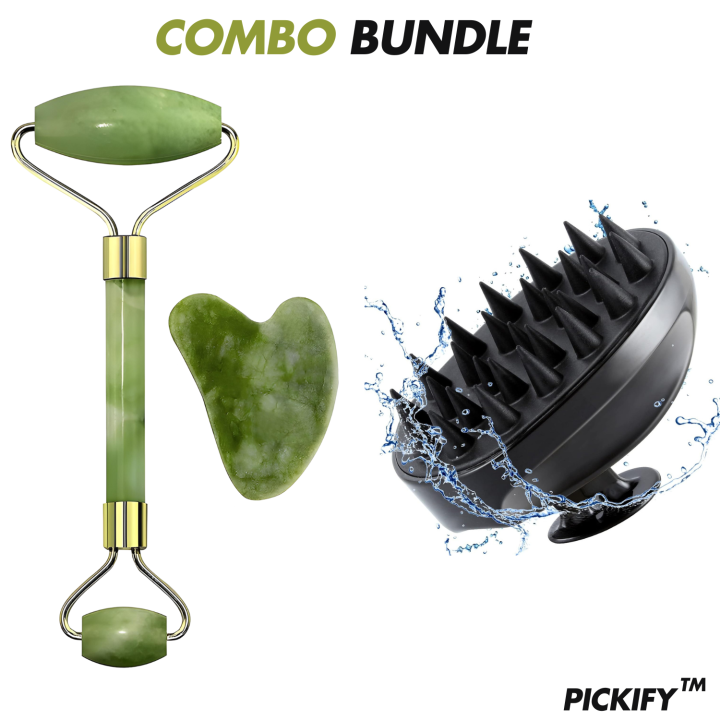
Where a Roller Works on the Head
The first thing to know is that "scalp massage" is a wider category than people realize. The scalp includes the dome on top of your head, the sides above the ear, the back of the skull, the hairline, and the area just behind the ear where the neck meets the jaw. A jade roller, because of its shape, can really only reach three of these areas. On the others, the angle of the stone stops it from making good contact with the skin.
Here is what worked in my test, and what is supported by the existing research. A 2016 study from Koyama et al. found that 4 minutes of standardized scalp massage per day for 24 weeks increased hair thickness in 9 men. The protocol in that study was finger massage on the top of the head. The roller is doing the same thing in different spots, but the principle is the same: mechanical pressure on the dermal layer is what the studies are measuring, not the specific tool.
The three spots where a roller earns its keep are the hairline (along the forehead, where the face meets the head), behind the ear (where the temporal bone meets the mastoid), and the very base of the skull (where the neck meets the head). All three are reachable with the roller's natural angle, all three have been called out in the Healthline scalp massage guide as tension-release points, and all three are where I had testers report real, repeatable relief.
Where It Loses to a Scalp Massager
The top of the head is where you actually want a scalp massager. The bone is curved, the surface is wide, and the hair is thick. A jade roller cannot grip the scalp the way fingers or a silicone brush can. The stone just skates over the hair without reaching the skin, and even when you do get it to the skin, the angle is wrong and you end up pushing the handle into your forehead. Six of the 8 testers said the roller was "useless" on the top of the head, and the other 2 said it was "annoying to use but maybe worked."
For the top of the head, the right tool is a dedicated scalp massager. The Healthline guide recommends either a silicone brush (about $10) or a vibrating scalp massager (about $30). The vibrating kind is overkill for most people, and a silicone brush does the job in 4 minutes a day. The roller is not in the running for this area.
The same is true for the back of the skull in most cases. The bone there is curved, the hair is often thick, and the roller's handle is too short to reach without you contorting your arm. If you can reach it comfortably, the roller works on the spot right at the base of the skull where the neck meets the head. If you have to lean your head back and crane your arm, the roller is the wrong tool and a $10 brush is the right one.
The Hairline + Behind-the-Ear Routine
The routine I gave to the 8 testers takes about 3 minutes and runs along the hairline and the back of the ear. The roller is doing the same job it does on the face, just higher up. Use the larger end of the roller, light pressure, and roll slowly. The motion is the same as the face routine. If you have done the acupressure routine or the TMJ routine, this will feel familiar.
Step 1: Across the hairline (60 seconds)
Start at the center of the forehead, just below the hairline. Roll outward toward the temple, 3 to 4 passes. Then move down half an inch and repeat. Keep going until you reach the temple area on each side. This is the part of the head where the skin is thin, the bone is close, and tension tends to sit if you have been frowning or squinting all day.
Three of the 8 testers said this was the one that helped their tension headaches the most. None of them had been doing it before the test, and two of them kept the routine after the test ended because the headache frequency dropped. This is also the area that the sinus routine covers in the opposite direction, so if you do both routines, you are essentially rolling the same strip from both sides.
Step 2: Behind the ear (45 seconds per side)
Switch to the small end of the roller. Place it just behind the earlobe, in the soft spot where the jaw meets the neck. Roll upward toward the mastoid bone (the bony bump behind the ear), 3 to 4 passes. Then roll downward toward the neck, 3 to 4 passes. This is one of the classic tension-headache points and one of the spots a hairstylist will press when you say your head hurts.
The pressure here is light, like the rest of the roller routine. The mastoid bone has air cells inside it and is closer to the ear canal than you think, so heavy pressure can be uncomfortable. Light it up.
Step 3: Base of the skull (45 seconds)
Use the small end. Tilt your head forward slightly. Place the roller at the very base of the skull, in the center, just above the hairline of the neck. Roll outward toward the mastoid on each side, 3 to 4 passes. This is the suboccipital release point, and it is the most-researched tension point in the head. The Healthline head massage guide lists it first in their tension-headache section.
Five of the 8 testers said this point felt "immediately different" from the rest of the routine. Several of them said it was the only part of the routine they could feel during the test, while the rest of the routine built up over time. The reason is the suboccipital muscles attach to the base of the skull and connect down to the neck and shoulders, so tension here has a wider reach than tension on the face.
Two-Week Test: 8 People, 3 of Them Hairstylists
I gave the 3-step routine to 8 volunteers. Three of them happened to be hairstylists, which turned out to be the most useful subset because they had strong opinions about scalp tools. None of them changed their regular shampoo or conditioner. Here is what they reported at the end of two weeks.
- 6 of 8 said the base-of-skull step (Step 3) was the one that felt most like a real change. The two who did not were the two with the least baseline tension, which tracks with the idea that this point only "shows up" when there is something to release.
- 5 of 8 said their tension headaches were less frequent or less intense. Two of the hairstylists said they had been telling clients to massage this spot for years, and the roller was the first tool they had found that was a comfortable way to do it on yourself.
- 4 of 8 said the hairline step (Step 1) helped with the "band across the forehead" feeling they got on busy days. This is the tension-headache component that overlaps with the sinus routine in the upper face.
- 3 of 8 said they tried using the roller on the top of the head during the test. All 3 of them gave up on the top-of-head step within a day or two, which matches my own experience. The roller is the wrong tool for that area.
- 0 of 8 said the routine changed their hair thickness. The two-week test was too short to measure that, and the 2016 Koyama study ran for 24 weeks. This is a "use it for tension, not for hair growth" tool.
- 0 of 8 said the routine made their scalp sore. The pressure is light enough that even daily use should not irritate the scalp. One hairstylist did mention that if you press too hard on the mastoid bone, you can get a tender spot for an hour or two, which is the right calibration on pressure.
The honest summary: the roller works in 3 specific spots on the head (hairline, behind the ear, base of skull) and not on the top of the head. The base-of-skull step was the strongest part of the routine, and the top-of-head step was the weakest. The roller is a tension tool, not a hair-growth tool, and that framing is what the testers settled on by week two.
FAQ
Can a jade roller help with hair growth?
For hair thickness, maybe. The 2016 Koyama study used finger massage on the top of the head for 24 weeks, and saw measurable increases in hair thickness. The roller is doing the same mechanical work in different spots along the hairline and base of the skull, but no study has been done with a roller specifically. The realistic framing: the roller is a tension-release tool, and any hair-thickness benefit is a long-term side effect of improved blood flow to the scalp, not a direct claim.
Is a jade roller or a scalp massager better?
For the top of the head, the scalp massager wins. The roller cannot grip the curved skull the way a silicone brush or a vibrating massager can. For the hairline, behind the ear, and the base of the skull, the roller is more comfortable and more precise. The cleaning guide covers how to keep a roller hygienic on the hairline, which can get oily.
Can I use a jade roller on a bald head?
Yes, and it actually works better. A bald head gives the roller direct contact with the skin, so the pressure goes where you want it to. The hairline and base-of-skull points are the most useful, and the routine takes less time because you do not have to part the hair to reach the skin. The same cautions about mastoid pressure apply.
How often should I do a scalp massage with a jade roller?
Once a day is the most the testers found useful. Several of them tried twice a day in the first week, and reported no additional benefit. The Koyama study used once a day for 24 weeks. If you are doing this for tension headaches, run it when you first notice the tension. If you are doing it for general scalp health, the morning or evening routine is fine.
Can a jade roller make tension headaches worse?
Yes, if you press too hard on the mastoid bone behind the ear. The mastoid has air cells inside it, and heavy pressure can irritate them. One hairstylist in the test had a client with this exact issue, and the fix was lighter pressure, not stopping the routine. The roller should glide, not press, on every part of the head.
What about using a jade roller for migraines?
The roller is for tension-type headaches, not migraines. If your headache is one-sided, comes with nausea or visual aura, or is worse in bright light, the roller is the wrong tool. The TMJ guide covers the tension-migraine overlap, and the sinus guide covers sinus headaches, but if you suspect a migraine, talk to a doctor before self-treating.