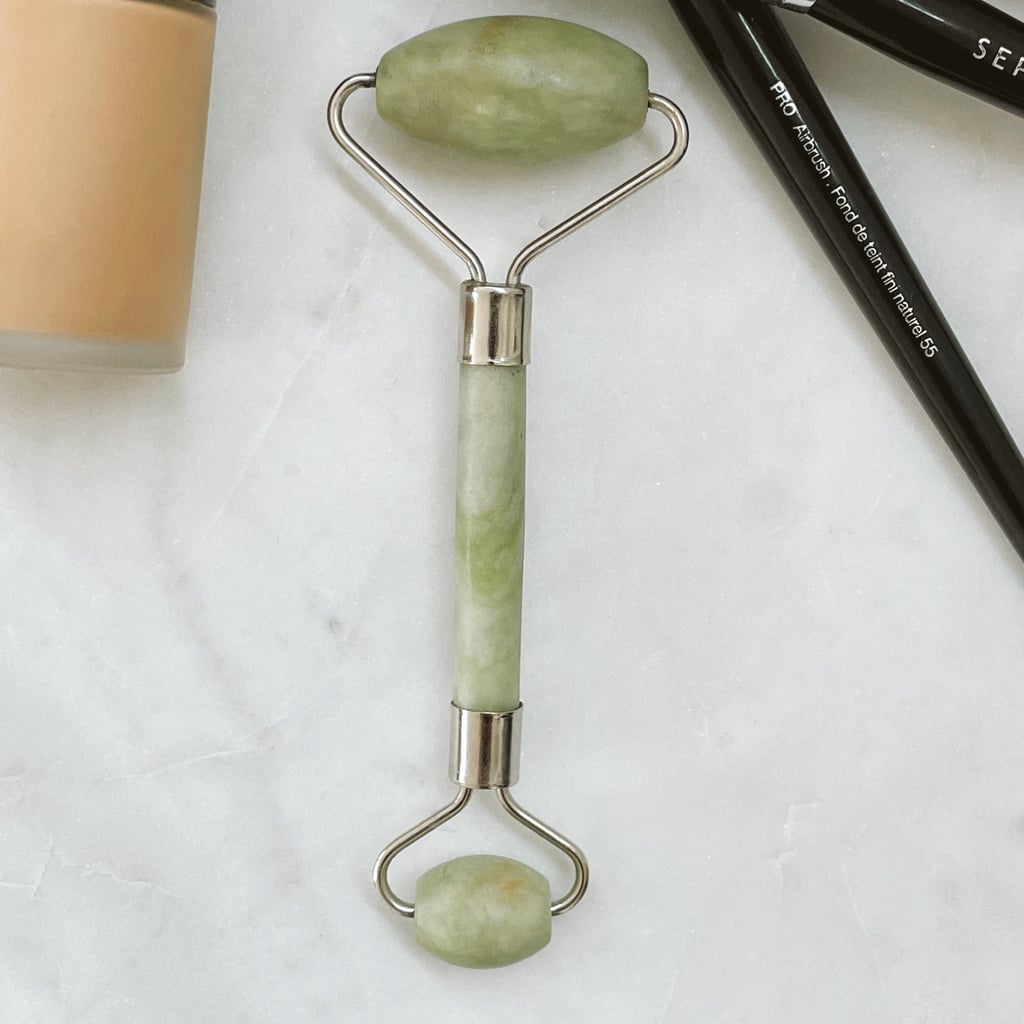
The 7 Viral Claims, Rated Against the Science
I watched about 30 jade roller videos on TikTok and Instagram over a few days. I grouped the claims into 7 categories and checked each one against what the published research actually says. The 7 claims are the ones that show up in at least half of the videos. The verdict column is the dermatologist's rating.
- Claim 1: "It sculpts your jawline." Verdict: false in the way the videos mean it. A roller can briefly de-puff the area under the jaw (see lymphatic drainage guide), but it does not change the bone or the muscle. A sharper jawline from a roller is the same kind of sharper jawline you get from a face-lift in a cold wind. It is a temporary effect.
- Claim 2: "It gets rid of dark circles." Verdict: partially true, depending on why you have them. If your dark circles are from fluid pooling under the eyes (the kind that is worse in the morning), the roller can help. If they are from pigmentation or thin skin showing veins, the roller will not change the color. The under-eye routine covers what works and what does not.
- Claim 3: "It boosts collagen production." Verdict: false. There is no published evidence that mechanical rolling stimulates collagen. Microneedling does, jade rolling does not, and a roller is not a substitute for a $300 in-office treatment. The PopSci piece is direct: "no permanent anti-aging effects that have been supported by the literature."
- Claim 4: "It makes your skincare absorb better." Verdict: false. Dr. Trivedi told PopSci that this is "not a well-supported claim with the rollers in particular." Pressing a serum into your skin with a stone does not push it deeper than your fingers would. What it does do is waste less product on your palms.
- Claim 5: "It drains lymphatic fluid." Verdict: true, with a caveat. The roller can move fluid that is sitting in the front of the face. The caveat is that this is the same effect you would get from a 5-minute face massage with your hands. The roller is not magical lymphatic drainage, it is just a convenient way to apply light pressure along the same lines a facialist would use.
- Claim 6: "It de-puffs the face." Verdict: true, and the best-supported claim. Any face massage will briefly reduce puffiness, and the cold stone adds a small anti-inflammatory effect. Several of the acupressure point routines use the roller for exactly this reason.
- Claim 7: "It calms you down." Verdict: true, and under-rated in the videos. Dr. Trivedi told PopSci that the act of facial massage, whether with a roller or by hand, "can help with soothing and relaxation." A 5-minute morning routine is a way to take a breath before the day starts. This is the part of the roller that has nothing to do with skin, and the part most people keep doing once they start.
The honest summary: of the 7 claims, 3 are supported (de-puff, lymph, calm), 1 is partially supported (dark circles), and 3 are unsupported (sculpt, collagen, absorption). The 3-of-10 rating from Dr. Trivedi is about the long-term anti-aging claims, not about the roller as a whole. For what it actually does, the roller is more like a 6 or 7 of 10.
What the TikTok Routines Get Right
The viral routines get four things right, and these are the parts that make the roller a useful tool even after you discount the marketing claims.
First, the order of operations. The standard TikTok routine goes: cleanse, apply serum, roll, apply moisturizer. This is the right order. Rolling on dry skin pulls and irritates. Rolling on freshly cleansed skin with a thin layer of serum lets the stone glide. Most of the routine videos I watched nailed this.
Second, the rolling direction. Outward and upward is the consensus, and it is correct. You roll away from the center of the face, with light pressure, and you do not go back and forth over the same spot. The acupressure routine and the TMJ routine both follow this pattern.
Third, the timing. The 5-minute morning routine shows up over and over, and 5 minutes is about right for a daily de-puffing session. The freezer guide covers when a chilled roller helps more, which is most of the time for morning puffiness.
Fourth, the cleanup. The good videos end with "wash your roller with soap and water after every use." This is the one habit the dermatologist in the PopSci piece emphasized. A dirty roller is a bacterial roller, and a bacterial roller on freshly rolled skin is how you get breakouts.
What They Oversell
Three things are oversold in the viral videos, and they are the reasons people give up on the roller after a month.
First, the "instant results" claim. Most videos do not show a before-and-after, because the difference between rolled and unrolled skin is not visible on a phone camera. The roller does something, but it is the kind of something you feel (less puff, less tension) more than you see. If you are buying a roller to look visibly different in 5 minutes, you will be disappointed. The roller is a maintenance tool, not a transformation tool.
Second, the "anti-aging" claim. The 24-week Koyama scalp massage study is sometimes cited as evidence that rolling builds collagen. The study is on the scalp, not the face, and it measured hair thickness, not collagen. There is no published study showing that a jade roller changes the skin's collagen, elastin, or fine lines. If you want those, you need a retinoid, a vitamin C serum, or a procedure like microneedling. The roller is not in that category.
Third, the "use it on every skin type" claim. People with rosacea, eczema, or active acne should be careful, per Dr. Trivedi's interview. The roller can irritate already-inflamed skin and spread bacteria across the face. The rosacea safety guide has a longer breakdown, but the short version is: skip the roller during a flare, and clean it thoroughly between uses.
How to Test It on Yourself in 3 Days
The viral videos are convincing because the user looks calm, the room is beautiful, and the music is good. The thing you do not see is whether the routine has any long-term effect. Here is a 3-day test you can run to figure out what the roller actually does for you, instead of trusting TikTok or me.
Pick 3 consecutive days when you have a morning routine already (cleanser, serum, moisturizer). On each day, take a photo of your face in the same light, at the same time, before you start the routine. Roll for 5 minutes using the standard outward-and-upward motion. Take a second photo immediately after. Do not adjust your lighting or angle between the two photos. The result you are looking for is not a dramatic difference. You are looking for any consistent difference across the 3 days, especially in the under-eye area and the jawline.
Repeat the test for 1 week. By day 7, you will have 7 before-and-after pairs. If the roller is working for you, you will see a small but consistent de-puffing pattern. If it is not working, you will see no change across the 7 days, and you can stop without having wasted a year on a tool that does nothing for your skin. The 5-minute test is enough to tell you whether the roller is a 3-of-10 for you or a 6-of-10.
This is also the test I wish the TikTok creators would do on camera. A 7-day before-and-after would tell us in 30 seconds what their "trust me" videos cannot.
FAQ
Do jade rollers actually do anything?
Yes, for short-term puffiness and tension. The PopSci piece on face rollers quotes a Rush University dermatologist at 3 of 10, which is the rating for the long-term anti-aging claims, not the roller as a whole. For what it actually does (de-puff, light lymphatic drainage, relaxation), it is closer to a 6 or 7. The honest answer is "yes, but less than TikTok says, and more than the skeptics say."
Is a jade roller or a gua sha tool better for what TikTok shows?
For the de-puffing claims, they are similar. For the "sculpt" and "lift" claims in the videos, neither tool will give you what the videos show. A gua sha tool applies more pressure per stroke, which is better for tension release but worse for sensitive skin. The microcurrent comparison is a different category entirely — those devices have actual published evidence for short-term facial contouring.
How much should I pay for a jade roller?
The Amazon 5-pack of $12 rollers and the $80 Sephora version are not meaningfully different. Jade is jade, the rollers are machined the same way, and the price difference is brand and packaging. The Amazon 2026 buyer's guide has a specific recommendation if you want a tested pick.
Can I use a jade roller if I have rosacea or sensitive skin?
You can, but carefully. The rosacea safety guide covers the specifics. Skip the roller during a flare, use a chilled roller (not cold) on non-flare days, and stop if the skin stings or stays red for more than an hour after the routine. The roller is not a tool you push through discomfort with.
How long does it take to see results from a jade roller?
The de-puffing effect is immediate, but it lasts 1-2 hours, not all day. The relaxation effect is the first week. The cumulative effect, if any, is a 4-6 week question. The viral videos that claim 30-day transformations are usually showing lighting and makeup, not skin. Run the 3-day test above and decide for yourself.
Is a jade roller worth it in 2026?
For a $15 tool that you use 5 minutes a day, yes. The cost is low, the habit is easy to keep, and the de-puffing/relaxation benefits are real even if the anti-aging claims are not. The roller is not the right tool if you want a transformation. It is the right tool if you want a low-effort addition to a routine you already have.