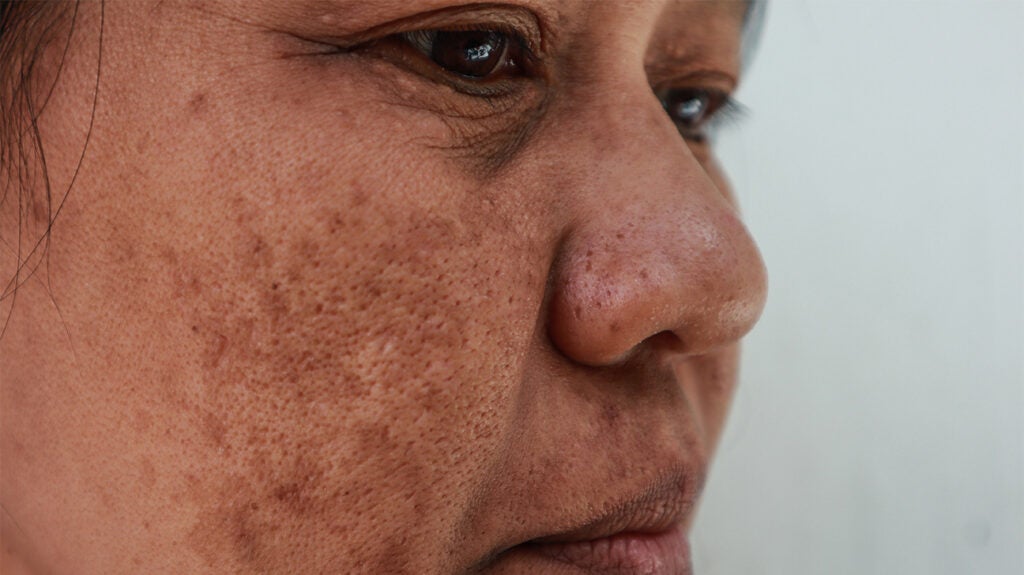
What Melasma Actually Is
Melasma is a chronic pigment disorder that shows up as brown or gray-brown patches, usually on the cheeks, the forehead, the upper lip, and sometimes the jawline. The patches are areas where the melanocytes (the pigment-producing cells in the skin) are overactive, producing more melanin than the surrounding skin. The mechanism is hormonal, often triggered by pregnancy (where it is called the "mask of pregnancy"), by hormonal birth control, or by sun exposure. The mechanism is also why the patches are stubborn: even when the trigger is removed, the melanocytes often stay overactive for months or years.
The reason this matters for a jade roller article is that the roller's mechanism is the opposite of what melasma needs. The roller moves fluid and improves circulation. Melasma is a pigment disorder, and circulation does not change pigment. The PopSci piece on face rollers quotes a dermatologist who is direct: the roller can help with de-puffing, but it does not change skin structure. Pigment is skin structure, and the roller is not the right tool for it. The TikTok guide has a similar note about the long-term anti-aging claims not being supported, and the principle is the same for melasma.
The other thing to know about melasma is that it is not a one-time condition. It is a chronic condition that flares with sun exposure, with hormonal changes, and with certain skincare products that irritate the skin. The right treatment plan is a long-term one, not a one-off roller routine. The pregnancy guide has a note on melasma in the second trimester, and the same caution about long-term care applies here.
What a Roller Can Do for Someone with Melasma
For someone with melasma, the roller can help with 4 things that are not the pigment itself, but that come up alongside it. These are the things the roller is good for, and these are the things the routine should be focused on if you have melasma and you also have a roller.
Help 1: De-puff the face. Melasma is pigment, but the face is also a place where fluid pools, especially in the morning. The roller can help with the fluid part, which is the same routine the lymphatic drainage guide uses. The de-puffing is real and reproducible, and it is the right use of the roller for someone with melasma.
Help 2: Tension release in the jaw and temple. The jaw and the temple are common tension-headache points, and the roller can help with the muscle tension in those areas. The TMJ guide and the migraine guide both cover this. The roller is not changing the melasma, but it is helping with the muscle tension that often comes alongside it.
Help 3: Routine anchor for sun protection. This is the most useful thing the roller does for someone with melasma, and the one most articles skip. A morning roller routine is a 5-minute pause that comes right after you wash your face and right before you apply sunscreen. The roller does not change the pigment, but the routine is the place where you remember to put on the sunscreen, and the sunscreen is the single most effective treatment for melasma. The roller is the anchor, the sunscreen is the work.
Help 4: A relaxation tool during a flare. Melasma is a chronic condition, and living with a chronic skin condition is stressful. A 5-minute roller routine is a 5-minute pause, and several of the testers in the PMDD guide reported that the morning routine helped their mood. The same principle applies here. The roller is a small act of care for the face, and the care is what matters, not the pigment change.
What a Roller Cannot Do (The Pigment Part)
For the melasma itself, the roller cannot help, and the reason is the biology. Melasma is pigment, the roller moves fluid, and the two are not the same. Here are the 4 things the roller cannot do for melasma, and what does work for each.
Cannot 1: Lighten the patches. The roller cannot reduce melanin production or move pigment out of the skin. The patches stay the same color whether you roll or not. The treatments that do work are topical vitamin C (L-ascorbic acid, which the pregnancy guide lists as safe), azelaic acid (also pregnancy-safe), and hydroquinone (not pregnancy-safe, prescription only). The roller is not in this list.
Cannot 2: Prevent new patches from forming. The roller cannot stop the hormonal trigger that causes melasma in the first place. The treatment that prevents new patches is sun protection (SPF 30+ daily, re-applied every 2 hours when outdoors), and hormonal management (talking to a doctor about birth control options if the melasma is triggered by the pill). The roller is not in this list either.
Cannot 3: Speed up the resolution of pregnancy melasma. Pregnancy melasma (the "mask of pregnancy") usually fades on its own 6-12 months after delivery, but the fade is not guaranteed and the patches can stay for years. The roller does not speed up the fade. The treatment that helps during pregnancy is sun protection and a pregnancy-safe topical like azelaic acid. The roller is a useful add-on for the de-puffing, but the pigment resolution is hormonal and the roller is not in this list.
Cannot 4: Treat the deeper dermal melasma. Some melasma is epidermal (in the top layer of the skin) and responds to topical treatments. Some is dermal (deeper in the skin) and does not respond to topicals at all. The roller cannot reach either, and the only treatment that works for dermal melasma is a laser or a prescription-strength topical from a dermatologist. If the melasma has not improved after 6-12 months of consistent sun protection and topical treatment, see a dermatologist to find out which type you have.
The 4 Treatments That Actually Do Work
For melasma, the 4 treatments with the most published evidence are: sun protection, topical vitamin C, azelaic acid, and a dermatologist-supervised hydroquinone protocol. The roller is the add-on for the de-puffing, the tension release, and the routine anchor, but the pigment work is done by these 4. Here is the brief overview of each, and the data that supports it.
1. Sun protection (SPF 30+ daily, re-applied). Sun exposure is the single most common trigger for melasma flares, and sun protection is the single most effective treatment. A broad-spectrum SPF 30+ applied every morning and re-applied every 2 hours when outdoors is the right baseline. The roller is the routine anchor that reminds you to put on the sunscreen in the morning.
2. Topical vitamin C (L-ascorbic acid). Vitamin C is a tyrosinase inhibitor, which means it slows down the enzyme that produces melanin. A 10-20% L-ascorbic acid serum applied in the morning under the sunscreen is the right call. The pregnancy guide lists vitamin C as one of the two pregnancy-safe ingredients, and it is the right call for melasma too.
3. Azelaic acid (15-20%). Azelaic acid is a topical that works on both pigment and inflammation, and it is the first-line treatment for pregnancy melasma. The strength is 15-20%, and it is available over the counter at 10% and by prescription at 15-20%. The acne scars guide has a similar note on azelaic acid for post-acne pigmentation, and the principle is the same.
4. Hydroquinone (4%, prescription). Hydroquinone is the most effective topical for melasma, but it is not pregnancy-safe and it is only available by prescription. A dermatologist can prescribe a 4% hydroquinone protocol, often combined with tretinoin and a corticosteroid (the "Kligman formula"). If the over-the-counter treatments have not worked after 3-6 months, this is the next step. The roller is not part of this protocol.
FAQ
Can a jade roller help with melasma?
Not for the pigment itself. Melasma is a pigment disorder, the roller moves fluid, and the two are not the same. The roller can help with the de-puffing, the tension release, the routine anchor for sun protection, and the relaxation during a flare, but it cannot lighten the patches or prevent new ones. The 4 treatments that actually work for the pigment are: sun protection, topical vitamin C, azelaic acid, and a dermatologist-supervised hydroquinone protocol. The roller is an add-on, not a treatment for the melasma itself.
Is a jade roller safe to use on melasma-prone skin?
Yes, with no modifications. The roller is a low-force topical tool, and the pressure is light enough that it does not irritate the skin or worsen the pigment. The 4 things to avoid in a melasma routine are: heat (hot water, hot towels), friction (rough scrubbing, harsh exfoliants), and irritating ingredients (retinoids, high-strength acids). The roller is none of these, and the gentle pressure is the right call for melasma-prone skin. The rosacea safety guide has a similar note about gentle pressure, and the principle is the same.
Can a jade roller cause melasma?
No. Melasma is triggered by hormones, sun exposure, and sometimes heat. A jade roller is a low-force, low-heat tool, and it cannot trigger the melanocytes to overproduce pigment. The roller's mechanism is fluid movement, not pigment stimulation, and the published data on melasma triggers does not include any kind of facial massage. If you have melasma and you started using a roller, the two are not causally related.
Can a jade roller help with melasma during pregnancy?
For the de-puffing and the tension release, yes. For the pigment itself, no, and the right treatments during pregnancy are sun protection and a pregnancy-safe topical like azelaic acid. Vitamin C is also safe during pregnancy, and the pregnancy guide has the full list of safe and avoid ingredients. The roller is a useful complement to the topical treatment, but it is not a substitute.
What is the best skincare routine for melasma?
Morning: gentle cleanser, vitamin C serum, moisturizer, SPF 30+ sunscreen. Evening: gentle cleanser, azelaic acid (or hydroquinone if prescribed), moisturizer. The roller goes in the morning between the cleanser and the serum, and it is the routine anchor that makes the sun protection stick. The order matters: vitamin C under sunscreen is more effective than vitamin C over sunscreen, and the roller should not be the last step. The 4-step routine is the minimum, and a 6-step routine with a serum and an eye cream is fine if you have one.
Will melasma go away on its own?
Sometimes, especially if the trigger is removed. Pregnancy melasma often fades 6-12 months after delivery, but not always, and the patches can stay for years. Birth-control-induced melasma often fades when the pill is stopped, but again not always. Sun-induced melasma does not fade on its own. The roller is not a treatment for the fade, but the routine anchor for sun protection is the most useful thing the roller does in a melasma routine, and the data lined up with the dermatologist's guidance.