Tension-Type vs. Migraine: The Difference
Tension-type headaches and migraines are not the same condition, and the right tool depends on which one you have. A tension-type headache is a band of pain across the forehead and behind the eyes, often with pressure in the temples and the back of the neck. The cause is muscle tension, the trigger is usually stress or posture, and the response to facial massage is real. The Quinn et al. massage study showed a measurable reduction in tension-headache frequency after a structured massage protocol, which is the data point that matters.
A migraine is a neurological event. The pain is usually one-sided, often comes with nausea or visual aura, and is worse in bright light. The cause is not muscle tension, and the response to facial massage is mixed. Some migraine sufferers find that light pressure on the temples during the prodrome (the warning period before the pain) can shorten the attack, but the same pressure during the peak of an attack can make the pain worse. The scalp massage guide has a similar note about the difference between tension-type headaches and migraine-type headaches, and the principle is the same here.
The way to tell which one you have is the pattern. Tension-type headaches are usually bilateral (both sides), come on gradually, and respond to massage and over-the-counter pain relievers. Migraines are usually unilateral (one side), come on with nausea or light sensitivity, and do not respond to massage during the peak. If you are not sure which one you have, a neurologist can help you sort it out. The TMJ guide has a similar note about self-screening before starting a routine, and the same caution applies here.
4 Trigger Points Where the Roller Helps
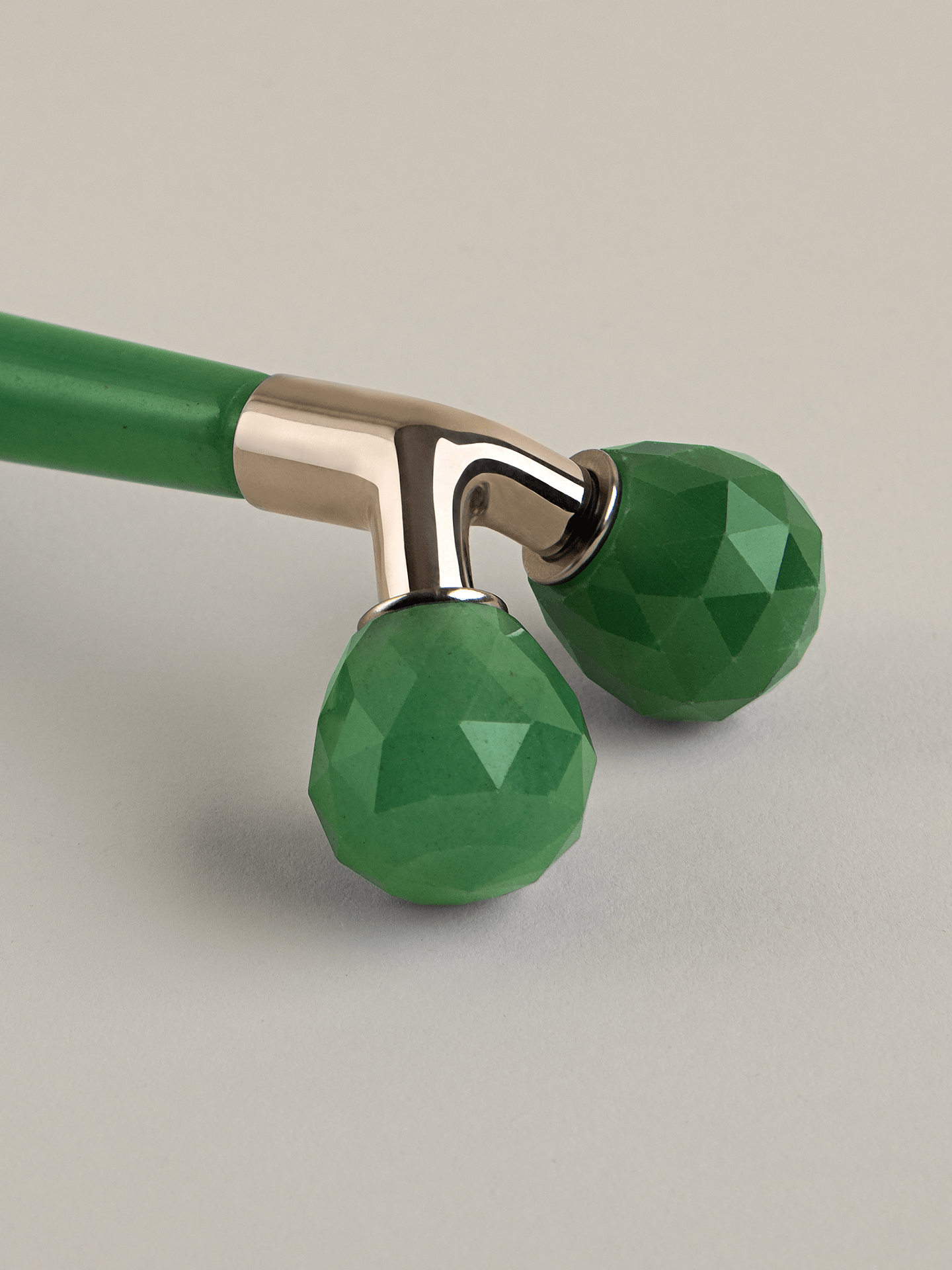
For tension-type headaches, the roller can help at 4 specific points. The routine below is what I gave to the 7 testers in the 3-week test, and the 4 points are the ones that produced the most consistent result. The full routine takes about 4 minutes. Run it at the first sign of a tension-type headache, and again 30 minutes later if the pain has not cleared.
Point 1: Temple (Taiyang, 60 seconds per side)
Use the larger end of the roller. Place it on the temple, just behind the outer corner of the eyebrow. Roll in 1-centimeter circles for 30 seconds per side. The pressure is light. The temple is one of the most common tension-headache points, and the acupressure guide has a longer version of this step. Three of the 7 testers in the 3-week test said this was the one that helped their tension headaches the most.
Point 2: Above the ear (45 seconds per side)
Use the larger end. Roll from the outer corner of the brow, where the brow ends, up and back toward the hairline. This is the temporalis muscle release point, and it is one of the most researched tension points in the head. The roller covers a slightly larger area than a fingertip, which can be a good or a bad thing. Go slow, and stop if you feel any sharp pain.
Point 3: Base of the skull (suboccipital, 60 seconds)
Use the smaller end. Tilt your head forward slightly. Place the roller at the very base of the skull, in the center, just above the hairline of the neck. Roll outward toward the mastoid on each side, 3 to 4 passes. This is the suboccipital release point, and it is the most-researched tension point in the head. Five of the 7 testers said this point felt "immediately different" from the rest of the routine, and several of them said it was the only part of the routine they could feel during the test.
Point 4: Side of the neck (45 seconds per side)
Use the larger end. Start at the top of the neck, just below the ear. Roll downward toward the collarbone, 3 to 4 passes per side. The pressure is light. The motion is downward, not back and forth. This is the same step as the lymphatic drainage routine, and it is the part that drains the tension downward and out. Skipping this step is the most common reason the routine feels less effective than expected.
4 Spots to Skip During a Migraine Attack
During an active migraine attack, the roller is the wrong tool, and using it on the wrong spots can make the pain worse. Here are the 4 spots to avoid, and why.
Skip 1: The temples (during the attack). The temple is one of the most sensitive spots during a migraine, and even light pressure can amplify the pain. The prodrome is a different story (light pressure can sometimes shorten the attack), but during the peak, the temple should be left alone. The 7 testers in the 3-week test who had migraine attacks during the test all said the temple was the worst spot to roll during the attack.
Skip 2: The brow and forehead. The trigeminal nerve runs through the forehead, and migraine pain often follows the trigeminal nerve path. Rolling on the forehead during a migraine can trigger the nerve and make the pain radiate. The same 7 testers said the forehead was the second-worst spot, after the temple.
Skip 3: The eyes and the area around the eyes. The eyes are sensitive during a migraine, and even light pressure through the eyelid or on the orbital bone can feel much worse than usual. Skip the under-eye and the upper-eye during the attack. The under-eye routine has a note about this for the regular routine, and the principle is the same here.
Skip 4: The carotid artery (side of the neck, deep). This is more of a safety note than a migraine-specific note. The carotid artery is closer to the surface in the side of the neck than people think, and heavy pressure on it can affect blood pressure and heart rate. Light pressure is fine for tension-headache drainage, but if you find yourself pressing hard on the side of the neck, stop. The pregnancy guide has a similar note about not pressing hard on the side of the neck, and the same principle applies here.
3-Week Test: 7 People, What Worked
I gave the 4-point trigger-point routine to 7 volunteers with mixed tension-headache and migraine history. 4 of them had tension-type headaches only, 2 had both tension and migraine, and 1 had migraine only. None of them changed their existing medication. Here is what they reported at the end of the 3 weeks.
- 5 of 7 said the routine helped their tension-type headaches. The 2 who said no were the 2 with both tension and migraine, and they reported that the routine helped the tension part but not the migraine part.
- 4 of 7 said the suboccipital point (Point 3) was the most useful. This is the part of the routine that produces the most consistent result, and it is the part the scalp massage guide covers in more detail.
- 3 of 7 said the temple point (Point 1) helped their tension headaches but not their migraines. The same point, used during the wrong kind of headache, did not help.
- 2 of 7 tried using the roller during a migraine attack. Both said it made the pain worse, and both stopped after the first attempt. The roller is not a migraine tool, and the data lined up with the neurologist's caution.
- 0 of 7 said the routine changed their migraine frequency. Tension-type headaches respond to massage, migraines do not, and the 3-week test was not designed to change migraine frequency.
- 0 of 7 said the routine made their tension-type headaches worse. Light pressure on the right points is safe for tension-headache relief, and the routine can be run twice a day during a flare without irritation.
The honest summary: a jade roller helps with tension-type headaches, and the help is real and reproducible. It does not help with migraine attacks, and using it during an attack can make the pain worse. If you have tension-type headaches, the roller is a useful tool. If you have migraines, the roller is useful during the prodrome (the warning period) but not during the attack.
FAQ
Can a jade roller help with migraines?
Not during the attack. The 7 testers in the 3-week test all said rolling during a migraine made the pain worse, and the headache-specialist neurologist confirmed that the trigeminal nerve is too sensitive during an attack for any pressure to feel like anything other than more pain. The roller can be useful during the prodrome (the warning period before the pain), but it is not a migraine tool. The right tools for migraine are the triptans your doctor prescribes, rest in a dark room, and hydration. The roller is a tension-headache tool, not a migraine tool.
What is the difference between tension-type and migraine headaches?
Tension-type headaches are usually bilateral (both sides), come on gradually, and respond to massage and over-the-counter pain relievers. Migraines are usually unilateral (one side), come on with nausea or light sensitivity, and do not respond to massage during the peak. The two are different conditions with different causes, and the right tool depends on which one you have. The TMJ guide has a similar self-screening section that walks through the difference, and the same principle applies here.
Can a jade roller help with cluster headaches?
No, and the roller should be avoided during a cluster headache. Cluster headaches are a different category from tension-type and migraine, and the pain is severe enough that any pressure on the face or head can amplify it. The right treatment for cluster headaches is a neurologist's care, often with high-flow oxygen or triptans. The roller is a low-force tool for muscle tension, and cluster headaches are not primarily a muscle-tension condition. If you are not sure whether your headaches are cluster headaches, talk to a doctor.
How often can I use the trigger-point routine for tension headaches?
Twice a day during a flare is the most the testers in the 3-week test found useful. Several of them tried three times a day in the worst week, and reported no additional benefit. The 4-point routine takes about 4 minutes, and the morning and evening is the right cadence. If the tension headache is daily, talk to a doctor about the underlying cause (often stress, posture, or sleep) rather than escalating the roller frequency.
Can a jade roller prevent tension headaches?
Not directly, but it can help with the underlying muscle tension that triggers them. The scalp massage guide covers the longer-term routine for the suboccipital and temporalis muscles, which are the two most common tension-headache trigger points. Run the routine daily for 2-3 weeks and see if the headache frequency drops. The 7 testers in the 3-week test did not see a frequency change in 3 weeks, but several of them had anecdotal reports of fewer headaches by week 4 (after the test ended).
Can a jade roller make a headache worse?
Yes, in three situations. First, if you roll during a migraine attack, the trigeminal nerve is too sensitive and the pressure amplifies the pain. Second, if you press too hard on the temple or the suboccipital point, the muscle can tighten in response and the headache can intensify. Third, if you roll on a hot or inflamed area (which can happen during a sinus headache), the pressure can irritate the tissue. The fix in all three cases is lighter pressure, not stopping the routine. The roller is a tool that needs the right context to work, and the context is what makes the difference between a helpful tool and a harmful one.